Pioneer DJM-A9 vs DJM-V10: which is worth buying?
Last updated: September 22, 2026
The Pioneer DJM-A9 is a comprehensive choice for a traditional four-channel professional booth. The DJM-V10 expands the possibilities with six channels, four-band EQ, a compressor on every channel, a Master Isolator and a dedicated Send FX section.
Using Sounds Market's September 2026 reference prices, approximately €2,200 for the A9 and €2,700 to €2,800 for the V10, we would choose the A9 if you do not need the additional tools. If you will use multiple sources, vinyl, drum machines, synths or external effects, we would pay the V10's €500 to €600 premium.
Sounds Market Score
Pioneer DJM-A9: 9.3/10
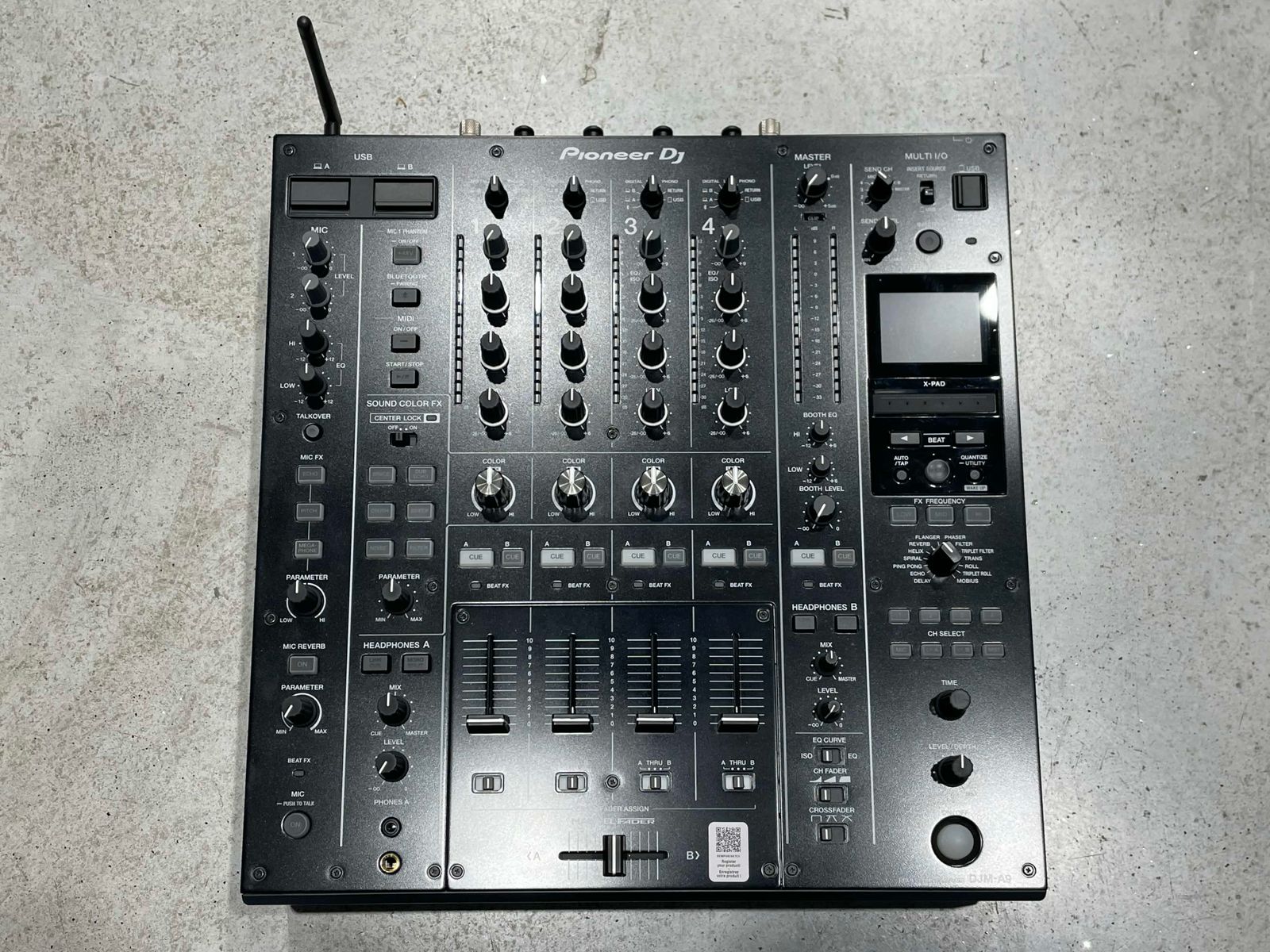
A modern professional mixer with a comprehensive feature set, particularly well suited to traditional setups using up to four channels. Connectivity, effects, B2B support and a familiar Pioneer DJ layout are its strengths. In our workshop experience, its main weak point is the Beat FX LEVEL/DEPTH potentiometer.
Pioneer DJM-V10: 9.6/10
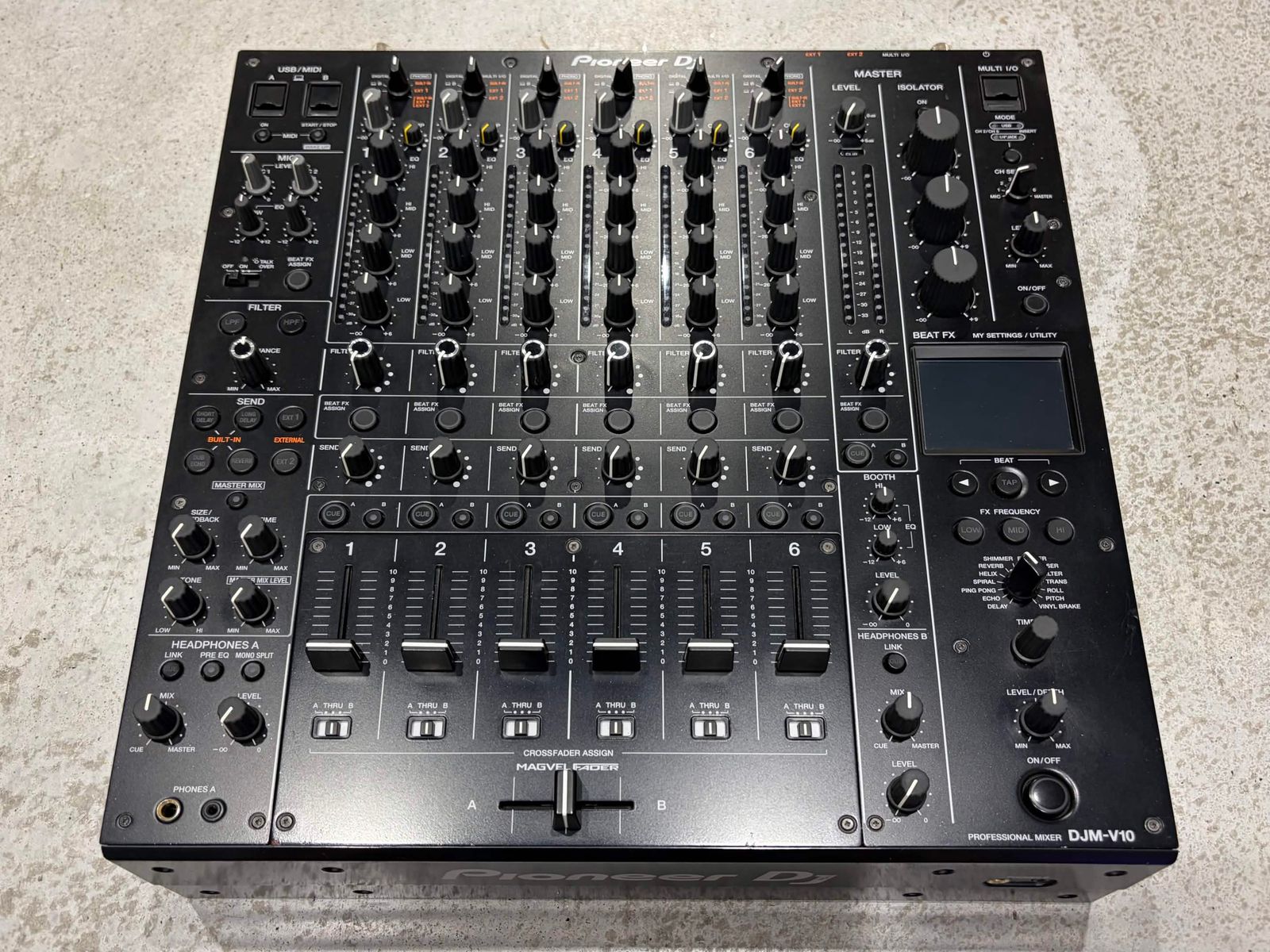
One of the most fully featured professional mixers we have used. Six channels, four-band EQ, individual compressors, a Master Isolator and flexible effects routing enable considerably more complex setups. The higher price is justified when you use these capabilities.
DJM-A9 vs DJM-V10: key differences
| Feature | DJM-A9 | DJM-V10 |
|---|---|---|
| Channels | 4 | 6 |
| Channel EQ | 3 bands | 4 bands |
| Compressor per channel | No | Yes |
| Master Isolator | No | 3 bands: Low / Mid / High |
| Sound Color / Filter FX | Sound Color FX | Filter per channel |
| Beat FX | Yes | Yes |
| Send FX | No equivalent section | Dedicated section |
| External Send/Return | Flexible Multi I/O | More extensive send architecture |
| Headphone systems | 2 independent | 2 independent |
| PRE EQ monitoring | No | Yes, on Headphones A |
| Link Cue | Yes | Yes |
| Booth EQ | Yes | Yes |
| Bluetooth | Yes | No |
| Crossfader | Yes | Yes |
| Version without crossfader | No | DJM-V10-LF |
| Best for | Traditional DJ setups | Complex setups and creative mixing |
Four channels vs six
The A9's four channels cover most traditional DJ setups. The V10's six are useful for much more than adding another two players: you can combine CDJs, turntables, drum machines, samplers, synths and effects returns.
If you only use two or four players, you may not need the extra capacity. In a hybrid setup, those channels can substantially change what you can connect and mix simultaneously.
Four-band EQ
The A9 uses the familiar High, Mid and Low layout. The V10 splits the midrange into two bands, giving you High, Hi Mid, Low Mid and Low.
That separation lets you make more precise space for different elements when layering sources. Three bands are sufficient for conventional mixing; with four, five or six sources playing together, the additional control becomes more valuable.
A compressor on every channel
Each of the V10's six channels has a dedicated compressor control beside Trim. It can give a quieter or less dense recording more presence and help it sit with the rest of the mix.
We particularly value this when combining older recordings or vinyl with modern productions, whose perceived loudness and dynamics can differ considerably. It provides a way to shape how the signal fits, beyond simply increasing gain.
The A9 does not have a dedicated compressor on each channel. For DJs working across eras and sources, this can matter much more than it first appears on a specification sheet.
Three-band Master Isolator
The V10's large Low, Mid and High controls act on the complete Master mix. This differs from channel EQ, which affects individual sources.
You can reduce the bass across the whole mix or shape mids and highs through a transition without adjusting every channel separately. For expressive mixing, it adds another direct creative control. The A9 does not have an equivalent Master Isolator.
Send FX and creative routing
The V10 has a dedicated Send FX section with built-in effects and parameter controls. Its importance lies in how you can select channels, adjust the amount sent from each and integrate external processors.
You can process a source, return it to the mix and combine it with other channels. When internal effects, external hardware and multiple sources are used together, this offers much more scope than occasionally adding an Echo or Reverb.
The A9 has flexible external connections, but no equivalent dedicated Send FX section with the V10's architecture.
Beat FX
Both have comprehensive Beat FX sections that cover traditional DJ use well. On the V10, Beat FX works alongside Send FX, allowing different processing systems to become part of the same setup.
Its creative advantage comes from how you can combine processing and routing, rather than simply counting effects. The A9 is already sufficient for occasional effects use; the V10 offers more scope when effects are central to your performance.
Two headphone systems: both are ready for B2B
Both mixers have two independent headphone systems. Each DJ can prepare tracks without changing the other DJ's monitoring.
Unlike the NXS2-to-A9 comparison, dual independent monitoring is not exclusive to the A9 here. Both are excellent B2B options.
PRE EQ monitoring: an extra advantage for the V10
The V10 lets you select PRE EQ on Headphones A, hearing the channel before its EQ adjustments. This preserves a full reference in your headphones while you cut frequencies in the mix.
Headphones B remains post-EQ. The A9 does not offer this PRE EQ selection. The V10 therefore adds flexibility specifically for the DJ using Headphones A, rather than giving both headphone systems the same extra option.
Link Cue
Both support Link Cue with compatible players connected through Pro DJ Link. With supported preview functions, you can check a track from the player's browser in your headphones before loading it.
This is useful for browsing large libraries and selecting the next track quickly. Compatibility depends on the connected player and configuration.
Connectivity
The A9 suits a modern traditional booth and adds practical features such as Bluetooth. Its Multi I/O also allows flexible external processing, including returning processed audio to another channel.
The V10 has no Bluetooth, but its priorities are multiple sources, external effects and more complex routing. Both have Booth EQ. For players and turntables alone, the A9 covers most needs; combine those with drum machines, synths and processors, and the V10's architecture becomes more useful.
Is there a difference in sound quality?
Both deliver professional audio quality. The V10's high-level audio architecture was designed with mixing multiple sources in mind.
At Sounds Market, we would not choose between them based only on small specification differences. The rest of the sound system strongly influences the result. The more useful distinction is how each mixer lets you work with your signals.
What actually changes when you are DJing?
For two or four players, three-band EQ and familiar Sound Color FX and Beat FX use, the A9 covers a traditional booth very well.
The V10 lets you organise sources across six channels, create space with four-band EQ, adjust their dynamics individually and process them through Send FX and external hardware. Headphones A preserves a PRE EQ reference, while the Master Isolator shapes the complete mix.
Its value lies in using those controls and signal paths. When they fit your performance, it offers much more than two extra channels.
Build quality
Both use good-quality components and are built for professional use. Our overall experience is positive.
On both, however, we inspect the Beat FX LEVEL/DEPTH potentiometer particularly carefully. Our workshop experience with this component has been less positive than with some earlier generations.
Reliability: DJM-A9 vs DJM-V10
DJM-A9
We consider the A9 reliable and well built overall, but have repaired numerous units with damaged LEVEL/DEPTH controls. In our experience, the control is more vulnerable to knocks and intensive use than the equivalent on models such as the DJM-900NXS2. It is a priority check on a used A9.
DJM-V10
Our overall assessment is very positive too. It is a robust mixer for complex professional setups, and we have not found a widespread issue that would make us advise against buying it.
Nevertheless, LEVEL/DEPTH is one of the components we have repaired most often. Numerous V10 units have arrived with this control damaged. We regard it as a specific weak point, despite the mixer's high overall rating.
The Sounds Market workshop's view
Both mixers perform well in our general workshop experience. The LEVEL/DEPTH potentiometer is a more vulnerable component that we have replaced many times on both models, compared with some earlier Pioneer generations.
That does not make either mixer unreliable, nor does it mean every unit will fail. It is a reason to inspect that control carefully when buying used. The V10's greater internal complexity can also make certain repairs more involved or expensive than on simpler mixers.
Used prices
Sounds Market reference prices for September 2026:
- DJM-A9: approximately €2,200.
- DJM-V10: approximately €2,700 to €2,800.
- DJM-V10-LF: approximately €3,000.
The standard V10 costs around €500 to €600 more than the A9. Condition, included accessories and market changes can affect prices.
Is the premium worth paying?
Yes, if you will use the V10's additional tools. For a traditional setup with two or four players, the A9 already offers a strong balance of features and price.
Six channels, four-band EQ, individual compression, a Master Isolator, Send FX and external hardware integration make the premium easier to justify. If these are part of your way of DJing and you know how to use them, we would pay the difference.
DJM-V10 vs DJM-V10-LF
The V10-LF retains the V10's core architecture and main features but removes the crossfader. Its channel faders have 60 mm of travel, compared with 45 mm on the standard V10.
The longer travel allows finer volume adjustments and suits DJs who mix entirely with channel faders. Neither version is automatically better: choose the standard V10 if you use a crossfader, or consider the LF if you never use one and prefer longer channel faders.
Which mixer should you choose?
Choose the DJM-A9 if...
- You use no more than four channels, mainly players or turntables.
- You want a modern professional Pioneer DJ mixer with a familiar layout.
- You do not need per-channel compression or four-band EQ.
- You do not need a Master Isolator or complex effects routing.
- You want strong value for a traditional setup.
Choose the DJM-V10 if...
- You need more than four channels or combine CDJs, vinyl, samplers, drum machines and synths.
- You want four-band EQ and individual compression.
- You mix older recordings, vinyl and modern productions.
- You want a Master Isolator and PRE EQ on Headphones A.
- Effects and external hardware are central to your performance.
- You want flexible routing and a particularly comprehensive professional toolset.
Comparison scores
Category scores assess these two models within this comparison. The Sounds Market Score is our overall editorial assessment of each product, independent of its comparison partner. It is not necessarily the arithmetic average of the categories.
| Category | DJM-A9 | DJM-V10 |
|---|---|---|
| Features | 9/10 | 10/10 |
| Flexibility | 9/10 | 10/10 |
| Effects / routing | 9/10 | 10/10 |
| Monitoring / CUE | 9.5/10 | 10/10 |
| Reliability | 9/10 | 9/10 |
| Value for money | 9/10 | 9/10 |
| B2B | 10/10 | 10/10 |
| Professional use | 10/10 | 10/10 |
| Sounds Market Score | 9.3/10 | 9.6/10 |
What other comparisons often miss
Compression can matter as much as six channels. It helps bring together older recordings, vinyl and modern productions with different dynamics. Four-band EQ, Send FX and the Master Isolator add control over individual sources and the full mix.
Dual monitoring is shared; PRE EQ is not. The V10 offers the extra selection on Headphones A, while Headphones B stays post-EQ.
Complexity only pays off when you use it. For two or four players, the A9 may be the more sensible buy. For multiple sources and creative effects, the V10 can justify the premium.
We check LEVEL/DEPTH on both. Numerous repairs in our workshop make it a priority when inspecting a used example.
Pioneer DJM V10 currently available
See all ->
Pioneer DJM-A9 currently available
See all ->
Frequently asked questions
Is the DJM-V10 better than the DJM-A9?
The V10 offers more mixing tools and flexibility. For a traditional setup using up to four channels, however, you may not need its additional features and the A9 can be the more sensible buy.
Is it worth paying more for the DJM-V10?
Yes, if you will use six channels, four-band EQ, individual compressors, the Master Isolator and advanced effects routing. Otherwise, the A9 will probably cover your needs.
How many channels does the DJM-V10 have?
The DJM-V10 has six channels, compared with four on the DJM-A9.
Does the DJM-V10 have a compressor?
Yes. Each of its six channels has an independent compressor control.
What is the DJM-V10's compressor for?
It lets you shape each signal's dynamics and presence individually. It is particularly useful when combining older recordings, vinyl and modern productions.
Does the DJM-V10 have a Master Isolator?
Yes. Its three-band Master Isolator has Low, Mid and High controls that affect the complete Master mix.
Does the DJM-V10 offer PRE EQ monitoring?
Yes, on Headphones A. Headphones B uses the post-EQ signal. The DJM-A9 does not offer PRE EQ selection.
Which is better for effects?
The DJM-V10, thanks to its dedicated Send FX section and more flexible routing. We would choose it if effects are central to your way of DJing.
Which is better for back-to-back sets?
Both are excellent, with two independent headphone systems each. The V10 additionally offers PRE EQ monitoring on Headphones A.
Which is more reliable?
Our overall experience is positive with both. We inspect the Beat FX LEVEL/DEPTH potentiometer carefully because we have repaired numerous units of both models with this control damaged.
What is the difference between DJM-V10 and DJM-V10-LF?
The V10-LF removes the crossfader and has 60 mm channel faders, compared with 45 mm on the standard V10. It suits DJs who mix exclusively with channel faders.
Which would we buy?
For a traditional setup with up to four channels, DJM-A9. If we will use six channels, individual compression, four-band EQ, Master Isolator, multiple sources and advanced effects, DJM-V10.
Thinking of upgrading your equipment?
You can sell your DJM-A9, DJM-V10 or other DJ equipment directly to Sounds Market, or trade it in towards your next purchase.
Verdict: DJM-A9 or DJM-V10?
The DJM-A9 offers a strong balance of features and price for a traditional booth using up to four channels. At the September 2026 reference price of around €2,200, it is easier to make full use of if you work with players, three-band EQ and familiar effects.
The DJM-V10, at approximately €2,700 to €2,800, provides six channels, four-band EQ, individual compression, a Master Isolator, PRE EQ on Headphones A and Send FX. It is one of the most comprehensive mixers we have used, allowing you to integrate multiple sources, manage their dynamics and build more elaborate effects combinations.
We would pay the extra €500 to €600 if you will use those features. Otherwise, we would choose the A9. Your way of DJing and the control you actually need should guide the decision.
- Most comprehensive feature set: DJM-V10.
- Effects and routing: DJM-V10.
- Monitoring: DJM-V10 for PRE EQ on Headphones A.
- Hybrid setups and more than four channels: DJM-V10.
- Vinyl and sources with different dynamics: DJM-V10.
- Value for a traditional booth: DJM-A9.
- No need for advanced features: DJM-A9.
- Our choice if you will use its full potential: DJM-V10.