Pioneer DDJ-1000 vs DDJ-FLX10: is the upgrade worth it?
Last updated: September 28, 2026
The Pioneer DDJ-FLX10 is a natural evolution of the DDJ-1000. Both are four-channel controllers for use with a computer, with full-size jog wheels, eight Performance Pads per deck and a layout closely related to a CDJ + DJM setup.
The main difference is dedicated Stems control through Track Separation. With rekordbox, the FLX10 lets you work separately with Vocals, Drums and Instrumental, including choosing which parts receive effects. That matters if you create live mashups or build performances around isolated musical elements.
Our workshop experience suggests a slightly more refined feel to some FLX10 components, especially its faders. However, the two remain very similar in concept, and we have not identified a serious recurring fault that makes us distrust either model.
Using September 2026 second-hand prices as a reference, the DDJ-1000 is around €1,100 and the DDJ-FLX10 around €1,350 per unit. For that roughly €250 difference, we would choose the FLX10 if we regularly used Stems. Otherwise, we would buy a DDJ-1000 in good condition and keep the saving.
Sounds Market Score
Pioneer DDJ-1000: 8.5/10
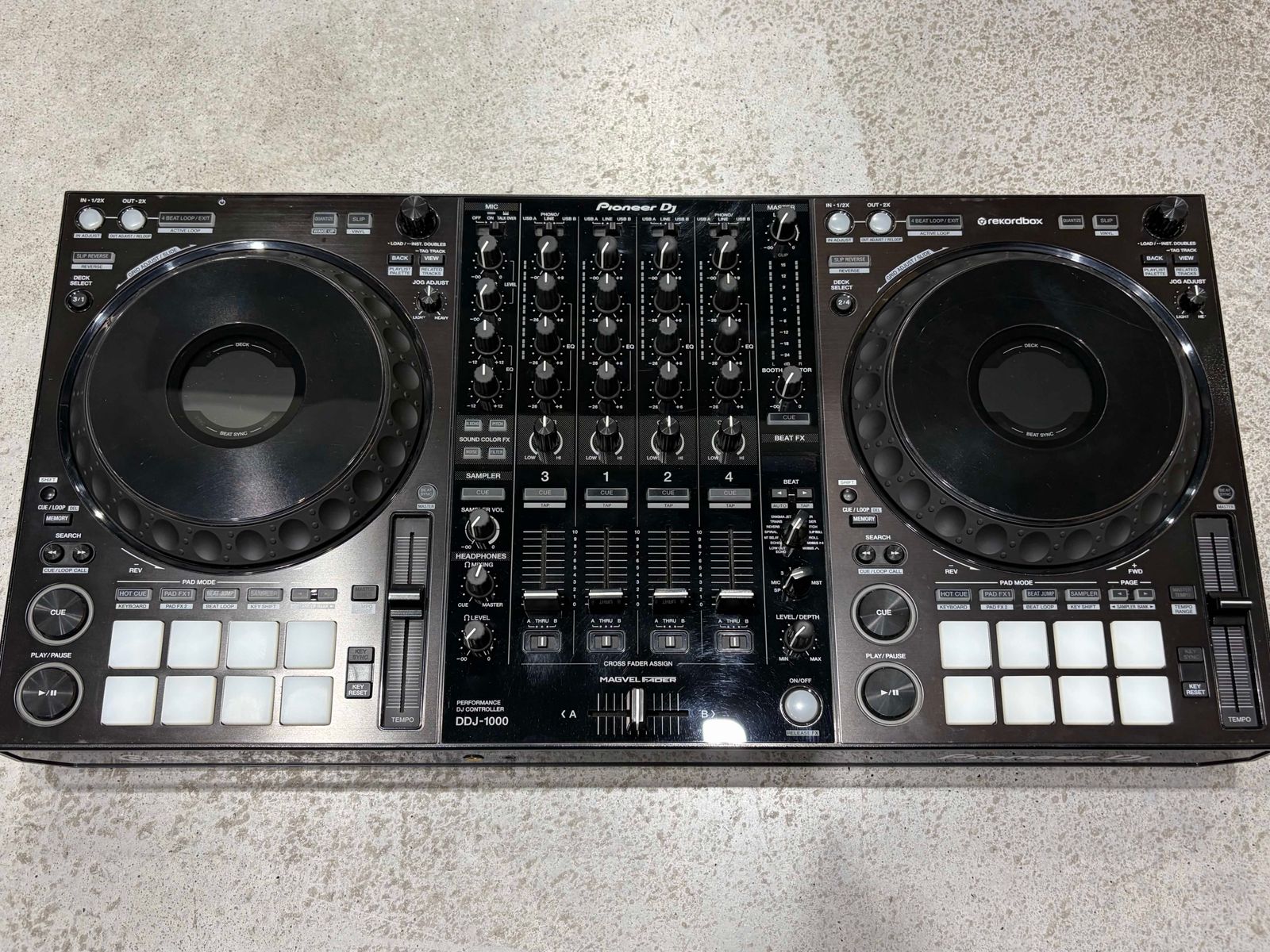
One of Pioneer DJ's strongest computer-based controllers. Its four channels, full-size jog wheels, excellent layout, eight Performance Pads per deck and comprehensive effects section remain competitive years after launch. At the reference used price of around €1,100, it is still an excellent buy.
Pioneer DDJ-FLX10: 8.9/10
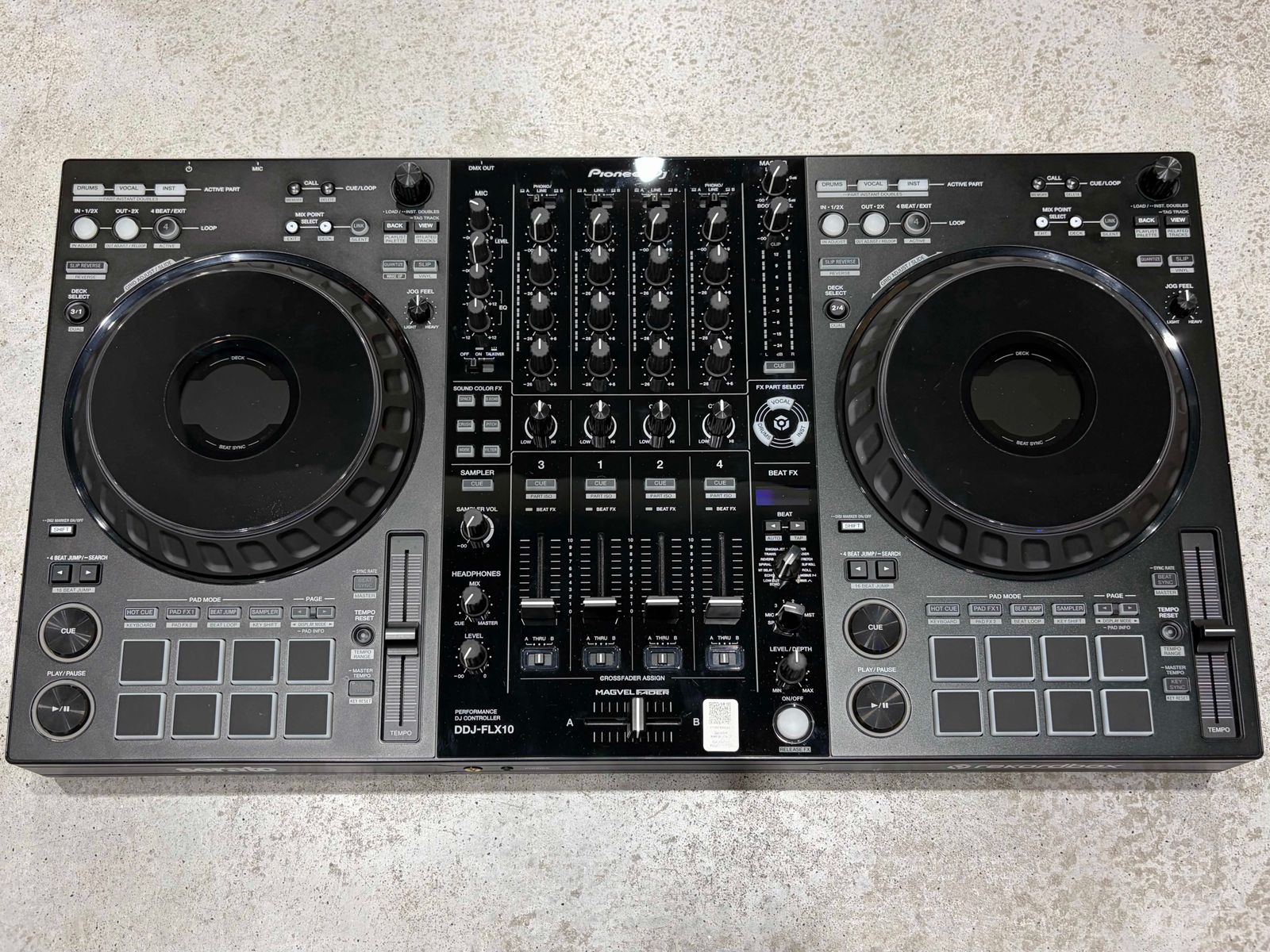
The FLX10 refines some components and modernises the DDJ-1000 concept, but its main attraction is Stems. Controlling vocals, drums and instruments directly from dedicated hardware opens creative possibilities that the DDJ-1000 does not provide in the same way. It is more capable overall, although not every DJ needs to pay the extra cost.
Pros and cons
DDJ-1000
Pros
- Four channels and full-size jog wheels.
- Jog Feeling Adjust and Color On Jog Display.
- Eight Performance Pads per deck.
- 14 Beat FX and four Sound Color FX.
- CDJ + DJM-inspired layout.
- Excellent rekordbox integration.
- Strong value and continued demand on the used market.
Cons
- No dedicated physical Stems controls comparable to the FLX10.
- Older model with a more limited On Jog Display.
- Channel faders can become scratchy with use.
- Some components feel slightly less refined than those on the FLX10.
DDJ-FLX10
Pros
- Advanced dedicated Stems controls through Track Separation.
- Separate control of Vocals, Drums and Instrumental with rekordbox.
- FX Part Select, Part ISO and Part Instant Doubles.
- More advanced On Jog Display.
- Four channels, full-size jog wheels and eight Performance Pads per deck.
- Slight refinements to component feel in our experience.
- Compatible with rekordbox and Serato DJ Pro.
- Integrated DMX output for rekordbox Lighting.
Cons
- Around €250 more at the reference prices.
- Much of its main advantage goes unused if you do not work with Stems.
- The core mixing experience remains very similar to the DDJ-1000.
- We have also seen fader wear on some units.
DDJ-1000 vs DDJ-FLX10: key differences
| Feature | DDJ-1000 | DDJ-FLX10 |
|---|---|---|
| Channels | 4 | 4 |
| Jog wheels | Full-size | Full-size |
| Jog Feeling Adjust | Yes | Yes |
| On Jog Display | Yes | Yes, expanded |
| Performance Pads | 8 per deck | 8 per deck |
| Dedicated Stems controls | No | Yes |
| Part ISO | No dedicated control | Yes |
| FX Part Select | No dedicated control | Yes |
| Mix Point Link | No | Yes, with rekordbox |
| Integrated DMX output | No | Yes, for rekordbox Lighting |
| rekordbox | Yes | Yes |
| Serato DJ Pro | No native support* | Yes |
| Approximate used price, September 2026 | €1,100 | €1,350 |
| Sounds Market Score | 8.5/10 | 8.9/10 |
The DDJ-1000SRT is a separate model designed for Serato DJ Pro. This comparison covers the original DDJ-1000 for rekordbox.
Two very similar controllers
The FLX10 keeps the DDJ-1000's basic approach: a four-channel controller used with a computer, large jog wheels, a central mixer and Performance Pads. Existing DDJ-1000 users will find the layout familiar, making the transition straightforward.
The evolution is in the additional control options, particularly for Stems, rather than a fundamental change to everyday mixing.
Stems: the main reason to buy the FLX10
With rekordbox, the FLX10's dedicated controls let you work with Vocals, Drums and Inst, meaning the instrumental part. The separation itself runs in the software on your computer.
You can remove a vocal, keep only the drums and instrumental, or combine elements from different tracks to build live mashups. The integration goes beyond simply muting parts.
Active Part
Turn individual parts on or off. For example, remove a track's vocal while its other elements continue playing.
Part ISO
Use the EQ knobs to adjust the individual parts' levels instead of applying conventional frequency EQ. This gives you hands-on control over the separated elements.
FX Part Select
Choose which parts receive an effect. You could apply Echo only to the vocal while leaving the drums and instrumental unaffected. For us, this is one of the most useful creative additions compared with applying a Beat FX to the whole channel.
Part Instant Doubles
Isolate a particular part and transfer it to another deck. This supports a style of performance built around live remixing and mashups.
Will you actually use Stems?
If you regularly build mashups, isolate vocals, remove drums or apply effects selectively, the FLX10 is a meaningful step forward.
If your sets mainly involve track selection, beatmatching, EQ, filters and conventional effects, many of these controls may see little use. The DDJ-1000 already offers four channels, excellent jog wheels, Performance Pads and a comprehensive effects section. That helps explain why it remains popular second-hand.
Jog wheels and On Jog Display
Both have full-size jog wheels with adjustable resistance through Jog Feeling Adjust. The DDJ-1000 already brought controller operation close to the feel of professional Pioneer DJ players.
The FLX10 expands the information available on its On Jog Display. Its display modes can show waveforms, deck information, artwork and other rekordbox-related parameters. What is available depends on the software and mode.
It is a useful improvement, but we would not replace a working DDJ-1000 solely for the display.
Mix Point Link
With rekordbox, Mix Point Link lets you set linked points so the next track starts at the chosen moment, automating part of the transition.
That frees your hands for effects or Stems-based mashups and supports more involved performances. We still consider it secondary to Track Separation when deciding whether to upgrade.
Software and lighting
The DDJ-1000 covered here is the rekordbox model. The DDJ-1000SRT is the separate Serato DJ Pro version. The FLX10 supports both rekordbox and Serato DJ Pro, although functions and control behaviour depend on the application.
Mix Point Link and lighting control through the DMX output operate with rekordbox. The FLX10's integrated DMX output lets you connect compatible lighting and control it through rekordbox Lighting without a separate DMX interface.
Build quality and faders
The two controllers are closely matched in construction. In our experience, some FLX10 components feel slightly more refined, particularly the faders. We would not describe this as a huge jump in quality.
The DDJ-1000 remains well built, with many units still working well after years of use. We have replaced faders on both models, so we would not buy the FLX10 purely in expectation of a dramatic durability improvement.
The Sounds Market workshop's view
Our overall experience with both is positive. Neither commonly arrives at our workshop because of a serious recurring or structural fault.
On the DDJ-1000, we mainly see ordinary wear, especially on faders. The jog wheels and Performance Pads generally hold up well, and we consider it a fairly reliable controller.
We have less accumulated long-term experience with the newer FLX10. We have replaced faders on some units, even though certain components feel slightly better resolved to us.
We have not identified a major recurring issue that makes us distrust either model. For a used unit, its actual condition and previous use matter more than the generation difference.
Second-hand prices
Our approximate September 2026 reference prices per unit are:
- DDJ-1000: €1,100.
- DDJ-FLX10: €1,350.
These are indicative used-market figures and vary with condition, accessories and market changes. The gap is roughly €250.
Is the FLX10 worth the extra money?
That mainly depends on how often you will use Stems. Around €250 more buys a newer controller, small hardware refinements, an expanded On Jog Display and additions such as Mix Point Link.
Those improvements alone would not make us rule out the DDJ-1000. Dedicated Stems controls are the key reason to pay more.
For frequent Track Separation use, we would choose the FLX10. If you do not use Stems, or only want to experiment occasionally, we would save the difference and buy a DDJ-1000 in good condition.
Who should choose each model?
Choose the DDJ-1000 if...
- Your budget is around €1,100.
- You do not need dedicated Stems controls.
- You want four channels and full-size jog wheels.
- You use rekordbox.
- You prefer a familiar CDJ + DJM-style layout.
- You want strong value and would rather save around €250.
Choose the DDJ-FLX10 if...
- You use Stems regularly.
- You want physical control over Vocals, Drums and Instrumental.
- You want to apply effects to individual parts.
- You create live mashups or remixes.
- You want a more informative On Jog Display.
- You use Serato DJ Pro as well as rekordbox.
- You prefer a newer controller.
- The extra €250 is affordable.
Comparison ratings
Category ratings are relative to the models in this guide. The Sounds Market Score is our independent overall assessment of each product and stays consistent across comparisons.
| Category | DDJ-1000 | DDJ-FLX10 |
|---|---|---|
| Features | 9/10 | 9.5/10 |
| Jog wheels and controls | 9.5/10 | 9.5/10 |
| Stems / performance | 7.5/10 | 10/10 |
| Effects | 9.5/10 | 10/10 |
| Build quality | 8.5/10 | 9/10 |
| Reliability | 9/10 | 9/10 |
| Value for money | 9.5/10 | 8.5/10 |
| Sounds Market Score | 8.5/10 | 8.9/10 |
The Sounds Market Score is an editorial judgement, not an arithmetic average of these categories or a ranking against the other model.
What other comparisons tend to miss
- The FLX10 does not make the DDJ-1000 obsolete. Their fundamental mixing experience is very similar, and the DDJ-1000 remains strong value if you do not use Stems.
- Dedicated Stems control is the decisive difference for us. Other refinements matter less to the buying decision.
- A newer, higher-scoring controller is not automatically the better purchase for every DJ. The FLX10 is more capable, but your actual use determines whether the premium is worthwhile.
Frequently asked questions
Is the DDJ-FLX10 better than the DDJ-1000?
It is more modern and more fully featured. The main upgrade is dedicated Stems integration, alongside the expanded On Jog Display, Mix Point Link and small hardware refinements. That does not make it the better purchase for every DJ.
What is the main difference between the DDJ-1000 and DDJ-FLX10?
The dedicated Stems controls. With rekordbox, the FLX10 lets you control Vocals, Drums and Instrumental directly and choose which parts receive effects.
Does the DDJ-1000 have Stems?
Track separation may be available through the DJ software, depending on its version and your configuration. The DDJ-1000 does not have the FLX10's dedicated physical Track Separation integration, which is the important distinction.
Which has better faders?
In our workshop experience, the FLX10's faders feel slightly more refined. However, we have replaced faders on both models and would not describe the construction difference as dramatic.
Which is more reliable?
Our experience is positive with both. The DDJ-1000 has had more years to demonstrate its durability, while we have less accumulated long-term experience with the newer FLX10.
Should I replace my DDJ-1000 with a FLX10?
If your DDJ-1000 works well, we would not upgrade automatically. The change makes most sense if you want regular Stems use to become part of your mixing.
Is a FLX10 worth around €250 more?
If you use Stems frequently, we think it can be. At the September 2026 reference prices, we would otherwise save the difference and buy a DDJ-1000 in good condition.
Which would Sounds Market buy?
For value at the September 2026 reference prices, the DDJ-1000, if we do not need dedicated Stems controls. The FLX10 scores higher overall, but we would save around €250 unless its advanced Stems integration is useful to us.
Thinking of upgrading your equipment?
If you own a DDJ-1000, DDJ-FLX10 or other DJ equipment, you can sell it directly to Sounds Market or put it towards your next purchase.
Conclusion: DDJ-1000 or DDJ-FLX10?
The DDJ-FLX10 is the more complete controller. It keeps the core strengths of the DDJ-1000 and adds dedicated Stems integration, a more informative On Jog Display and functions aimed at creative performances. Its Sounds Market Score is 8.9/10, compared with 8.5/10 for the DDJ-1000.
The DDJ-1000 remains an excellent second-hand choice because those additions do not fundamentally change how every DJ mixes. If you regularly isolate vocals, drums and instruments for live mashups, we would pay the difference for the FLX10. For a more traditional workflow, we would save approximately €250 and choose a DDJ-1000 in good condition.
- Most complete: DDJ-FLX10.
- Best for Stems: DDJ-FLX10.
- Best On Jog Display: DDJ-FLX10.
- Build quality: slight advantage to the DDJ-FLX10.
- Jog wheels: effectively a tie.
- Reliability: tied in our current assessment.
- Best value for money: DDJ-1000.
- Our choice with regular Stems use: DDJ-FLX10.
- Our choice without regular Stems use: DDJ-1000.