Pioneer DDJ-1000 vs XDJ-RR: computer-based controller or all-in-one system?
Last updated: September 28, 2026
The Pioneer DDJ-1000 and XDJ-RR offer two different ways to DJ at very similar used prices. Using September 2026 as a reference, the DDJ-1000 is around €1,100 and the XDJ-RR around €1,000 per unit.
The DDJ-1000 needs a computer to run its decks with rekordbox. In return, it offers four channels, full-size jog wheels, eight Performance Pads per deck, a much broader effects section and a CDJ + DJM-inspired layout.
The XDJ-RR is simpler: two channels, smaller jog wheels, four pads per deck, a seven-inch non-touch screen and three Beat FX. Its key advantage is standalone USB playback. Prepare your music in rekordbox, export it to a USB drive and play without a laptop.
If you want to keep using a computer, we would choose the DDJ-1000 for its extra control and possibilities. If your priority is leaving the laptop behind, the XDJ-RR is an affordable route into Pioneer DJ's all-in-one workflow.
Sounds Market Score
Pioneer DDJ-1000: 8.5/10
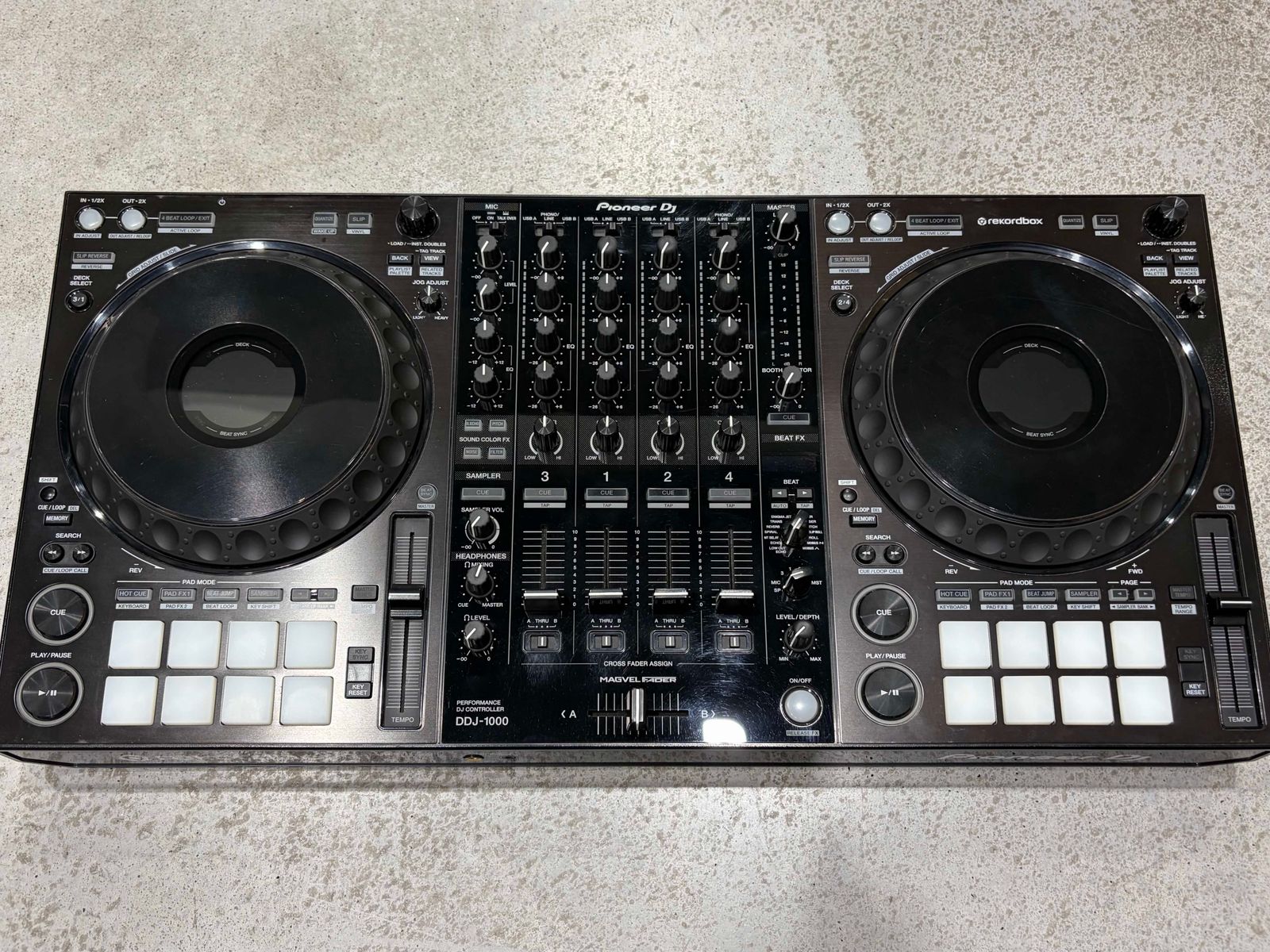
A benchmark among computer-based DJ controllers for many years. Its four channels, large jog wheels, Performance Pads and layout inspired by the CDJ-2000NXS2 + DJM-900NXS2 offer a very complete experience at the reference used price of around €1,100. Its main limitation is clear: operating its decks as a controller requires a computer.
Pioneer XDJ-RR: 8.0/10
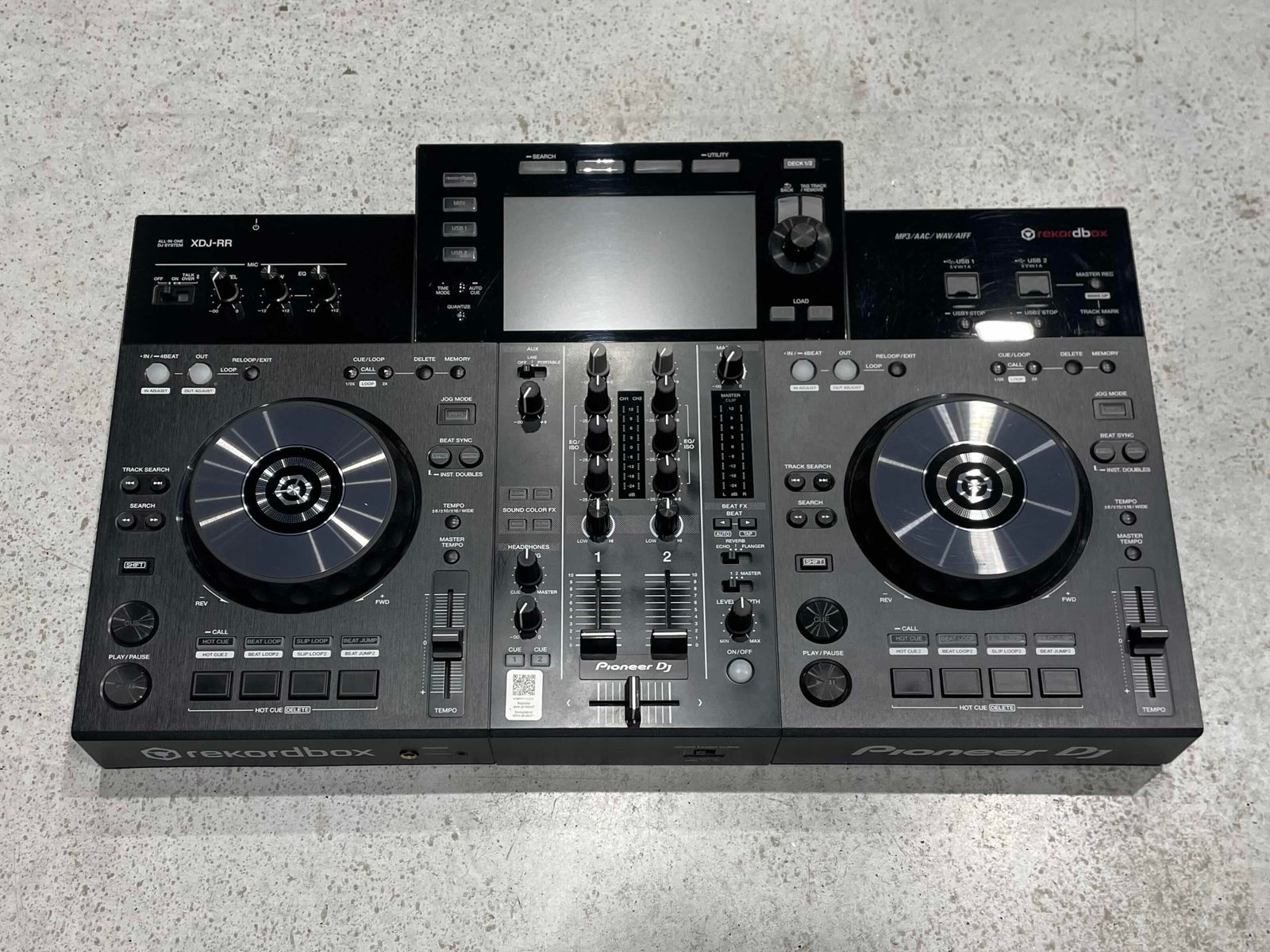
The entry-level Pioneer DJ all-in-one of its generation. It is simpler than models such as the RX2 in construction, jog wheels, effects and mixing options, but it can play directly from USB without a computer. At the reference price of around €1,000, it remains an appealing way to move into standalone DJing.
Pros and cons
DDJ-1000
Pros
- Four channels.
- Full-size jog wheels with Jog Feeling Adjust.
- Color On Jog Display.
- Eight Performance Pads per deck.
- 14 Beat FX and four Sound Color FX.
- CDJ + DJM-inspired layout.
- Extensive possibilities with rekordbox.
- Excellent second-hand value.
Cons
- Requires a computer to operate its decks as a controller.
- Channel faders do not match the feel or construction of professional Pioneer DJ mixers.
- Some components and finishes feel less premium than separate professional units.
- Channel faders can become scratchy with age and use.
XDJ-RR
Pros
- Standalone playback directly from USB.
- Integrated seven-inch screen.
- Light and easy to transport.
- Two USB-A ports.
- Direct USB recording.
- Good overall reliability.
- Affordable entry into Pioneer DJ's standalone workflow.
Cons
- Only two channels.
- Non-touch screen.
- Small jog wheels.
- Four Performance Pads per deck.
- Only three Beat FX.
- Lightweight construction with substantial use of plastic.
- Fewer creative options than the DDJ-1000.
- Shorter physical pitch fader travel.
DDJ-1000 vs XDJ-RR: key differences
| Feature | DDJ-1000 | XDJ-RR |
|---|---|---|
| Type | DJ controller | All-in-one system |
| USB playback without a computer | No* | Yes |
| Channels | 4 | 2 |
| Jog wheels | Full-size | Compact |
| Jog Feeling Adjust | Yes | No |
| Jog Display | Yes | No |
| Main screen | None | 7 inches |
| Touchscreen | Not applicable | No |
| Performance Pads | 8 per deck | 4 per deck |
| Beat FX | 14 | 3 |
| Sound Color FX | 4 | 4 |
| Direct USB recording | No | Yes |
| Approximate used price, September 2026 | €1,100 | €1,000 |
| Sounds Market Score | 8.5/10 | 8.0/10 |
The DDJ-1000 can mix external sources without a computer. To operate its decks as a DJ controller, it needs rekordbox running on a PC or Mac.
The key choice: computer-based controller or all-in-one
With the DDJ-1000, you bring a computer and use rekordbox to manage deck playback. With the XDJ-RR, you can prepare music in rekordbox beforehand, export it to USB and then play directly from that drive.
The RR's preparation and playback process is closer to using CDJs. If removing the laptop from the booth is your priority, accepting its hardware limitations may be worthwhile.
DDJ-1000: more hardware for almost the same price
The DDJ-1000 offers more controls and functions. Its four channels, versus the RR's two, let you work with four decks or integrate external sources.
Its layout draws on the CDJ-2000NXS2 and DJM-900NXS2 setup. The positions of the jog wheels, mixer and effects controls feel familiar when you move to a professional Pioneer DJ booth. This helped make it a reference point among rekordbox controllers.
Jog wheels: a clear advantage for the DDJ-1000
The DDJ-1000 has full-size jog wheels, integrated displays and Jog Feeling Adjust for changing their resistance. The XDJ-RR's smaller, simpler wheels have no resistance adjustment.
You can still mix well on the RR. However, if you are used to professional CDJs or value manual jog control, the DDJ-1000 feels considerably closer to a professional Pioneer DJ player.
Our workshop experience with its jog wheels is also positive. We occasionally repair them, but overall the mechanisms are solid and age reasonably well.
Pitch faders and tempo control
The DDJ-1000's pitch faders have longer physical travel than those on the XDJ-RR. That gives you more space for small tempo adjustments and can feel more comfortable if you regularly beatmatch manually.
The RR's shorter faders still allow manual mixing, but leave less physical travel for those fine movements. This may matter less if you use Sync frequently. For DJs who work the pitch faders constantly, it is a practical advantage of the DDJ-1000.
Performance Pads and creative options
The DDJ-1000 provides eight Performance Pads per deck for functions available through rekordbox, including Hot Cues, Pad FX, Beat Jump, Sampler, Keyboard Mode, Beat Loop and Key Shift.
The XDJ-RR supports Hot Cues, Beat Loop, Slip Loop and Beat Jump, so it still has useful performance tools. Its four pads per deck and simpler approach nevertheless offer less scope.
If pads and Hot Cues are central to your sets, the DDJ-1000 gives you more to work with.
Effects: another advantage for the DDJ-1000
The XDJ-RR offers three Beat FX:
- Echo.
- Reverb.
- Flanger.
It also has four Sound Color FX:
- Filter.
- Noise.
- Dub Echo.
- Pitch.
That may be enough for traditional mixing. The DDJ-1000 has 14 Beat FX and four Sound Color FX, bringing its effects section closer to professional Pioneer DJ mixers.
If you use lots of effects, the DDJ-1000 is the stronger option. If you mainly use Filter, Echo and Reverb, the RR's limits may matter much less.
The XDJ-RR's advantage: connect a USB drive and play
The RR's main attraction is its simplicity. Arrive with music prepared in rekordbox, connect your USB drive and start playing without a laptop.
Its two USB-A ports are useful for DJ changeovers, and Master Rec lets you record your set directly to a USB device.
Its value is in providing a complete DJ system that handles playback independently of a computer. That can outweigh the DDJ-1000's additional channels, larger jog wheels and broader effects.
Build quality
Neither is, in our view, the strongest example of materials in Pioneer DJ's historical range. The DDJ-1000 is well built and combines aluminium and acrylic on its top panel, but parts of the unit use plenty of plastic and do not feel like separate professional equipment.
The XDJ-RR feels lighter still. At 5.2 kg, it is designed as an accessible, portable all-in-one. That helps with transport and is also reflected in the feel of its materials.
It belongs at the entry point of its generation's all-in-one range. You should assess it on that basis, with different expectations from an RX2 or XDJ-XZ.
The Sounds Market workshop's view
Our overall experience with both is positive. We have not identified a major structural issue that would make us advise against buying either used.
The DDJ-1000's jog wheels generally hold up well, and its Performance Pads are not a particular source of trouble for us. Channel faders deserve closer attention. They feel lighter than those in professional mixers such as the DJM-900NXS or DJM-900NXS2 and can develop noise or become scratchy over time.
That does not mean every DDJ-1000 will have this problem. It is one of the components we check carefully on a used unit.
The XDJ-RR also has good general reliability. Its materials feel simpler, but we have not identified a serious recurring fault that makes us consider it unreliable.
For both models, the condition of the individual unit matters more than a theoretical reliability difference.
Second-hand prices
Our September 2026 reference prices per unit are approximately:
- DDJ-1000: €1,100.
- XDJ-RR: €1,000.
These are indicative used-market prices and can vary with condition, accessories and market changes. The gap is small enough that your preferred way of DJing should matter more than price alone.
Which offers more for your money?
For hardware and functions, the DDJ-1000. Around €100 more buys four channels, full-size jog wheels with resistance adjustment and displays, eight pads per deck and a much broader effects section.
The RR provides a different benefit: playback without a computer. Fewer controls do not automatically make it worse value when its standalone capability is the feature you need most. The products address different priorities.
Who should choose each model?
Choose the DDJ-1000 if...
- You are happy DJing with a computer.
- You want four channels and large jog wheels.
- You prefer a CDJ + DJM-style layout.
- You use effects and Performance Pads extensively.
- You value longer pitch fader travel for manual tempo adjustments.
- You want extensive features at around the €1,100 reference price.
Choose the XDJ-RR if...
- You want to play without a computer.
- You want to prepare USB drives in rekordbox.
- You are buying your first all-in-one.
- Two channels are enough.
- You do not need a large effects selection.
- You want a light, easily transported unit.
- You want to get used to Pioneer DJ's USB workflow.
- You want to record sets directly to USB.
Comparison ratings
Category ratings are relative to the models in this guide. The Sounds Market Score is our independent overall assessment of each product and stays consistent across comparisons.
| Category | DDJ-1000 | XDJ-RR |
|---|---|---|
| Features | 9.5/10 | 7.5/10 |
| Jog wheels and controls | 9.5/10 | 7.5/10 |
| Effects | 9.5/10 | 7.5/10 |
| Build quality | 8.5/10 | 8/10 |
| Reliability | 9/10 | 9/10 |
| Portability | 8/10 | 9.5/10 |
| Standalone workflow | Not applicable | 9/10 |
| Value for money | 9/10 | 8.5/10 |
| Sounds Market Score | 8.5/10 | 8.0/10 |
The Sounds Market Score is an editorial assessment, not an arithmetic average of the categories or a ranking against the other model.
What other comparisons tend to miss
- More features do not automatically mean a better purchase. The DDJ-1000 cannot meet your main requirement if you want USB playback without a laptop.
- Standalone playback does not guarantee more advanced hardware. The RR is an entry-level all-in-one; the DDJ-1000 has more channels, larger jog wheels, more pads and broader creative options.
- The DDJ-1000 still makes sense used. The later DDJ-FLX10 does not remove the appeal of four channels, full-size jog wheels and rekordbox at this price.
Pioneer XDJ RR currently available
See all ->
Frequently asked questions
Does the DDJ-1000 work without a computer?
It cannot play music through its decks as a standalone unit. That requires rekordbox on a PC or Mac. Its mixer section can work with external sources without a computer.
Does the XDJ-RR work without a computer?
Yes. Prepare your music in rekordbox, export it to a USB device and connect it directly to the XDJ-RR. Standalone USB playback is its main advantage here.
Which is better, the DDJ-1000 or XDJ-RR?
The DDJ-1000 offers more hardware and functions: four channels, larger jog wheels, more Performance Pads and more effects. For playing without a computer, we would choose the XDJ-RR.
Which feels closer to using CDJs?
Physically, the DDJ-1000, thanks to its full-size jog wheels and NXS2-inspired layout. For music preparation and USB playback, the XDJ-RR offers a process closer to using CDJs.
Does the XDJ-RR have a touchscreen?
No. It has a seven-inch colour screen, but it is not touch-sensitive.
How many effects does the XDJ-RR have?
It has three Beat FX: Echo, Reverb and Flanger, plus four Sound Color FX: Filter, Noise, Dub Echo and Pitch.
Which is more reliable?
Our experience is good with both, with no clear winner. On a used DDJ-1000, we would pay particular attention to the channel faders. On either unit, check jog wheels, pads, buttons, connections and other components subject to wear.
Which would Sounds Market buy?
If using a computer, the DDJ-1000, with its extensive features at the September 2026 reference price of around €1,100. If our priority is leaving the laptop behind and playing from USB, the XDJ-RR.
Thinking of upgrading your equipment?
If you own a DDJ-1000, XDJ-RR or other DJ equipment, you can sell it directly to Sounds Market or put it towards your next purchase.
Conclusion: DDJ-1000 or XDJ-RR?
The choice comes down to how you want to play. At the September 2026 reference price of around €1,100, the DDJ-1000 offers four channels, full-size jog wheels, eight Performance Pads per deck and a comprehensive effects section. If using a computer suits you, it is our choice.
The XDJ-RR is more limited in channels, jog wheels, pads, effects and construction. However, it lets you connect a USB drive prepared in rekordbox and play without a laptop. For a first step into Pioneer DJ's all-in-one range, that freedom can matter more than extra controls.
- Most complete: DDJ-1000.
- Best jog wheels: DDJ-1000.
- More channels: DDJ-1000.
- More effects and creative options: DDJ-1000.
- Better manual pitch control: DDJ-1000.
- Physically closer to a CDJ + DJM setup: DDJ-1000.
- Best for playing without a computer: XDJ-RR.
- Best first all-in-one of these two: XDJ-RR.
- Our choice with a computer: DDJ-1000.
- Our choice for leaving the computer behind: XDJ-RR.