Pioneer DDJ-800 vs DDJ-1000: is the DDJ-1000 worth the extra money?
Last updated: September 30, 2026
The Pioneer DDJ-800 and DDJ-1000 belong to the same generation of rekordbox controllers. Both offer a layout inspired by professional Pioneer DJ equipment, Performance Pads, effects and displays in the centre of the jog wheels.
The main choice is between the compact DDJ-800 with two physical channels and the DDJ-1000 with four channels and full-size jog wheels, which feels closer to using CDJ players.
Using September 2026 second-hand prices as a reference, the DDJ-800 is around €800 and the DDJ-1000 around €1,100 per unit. At that difference of roughly €300, we would choose the DDJ-1000 if space and budget allow.
The DDJ-800 remains a very good choice if portability matters and you only need two channels. However, our workshop experience also favours the DDJ-1000's jog wheels: we have repaired considerably more jog wheel and bearing problems on the DDJ-800.
Sounds Market Score
Pioneer DDJ-800: 8.2/10
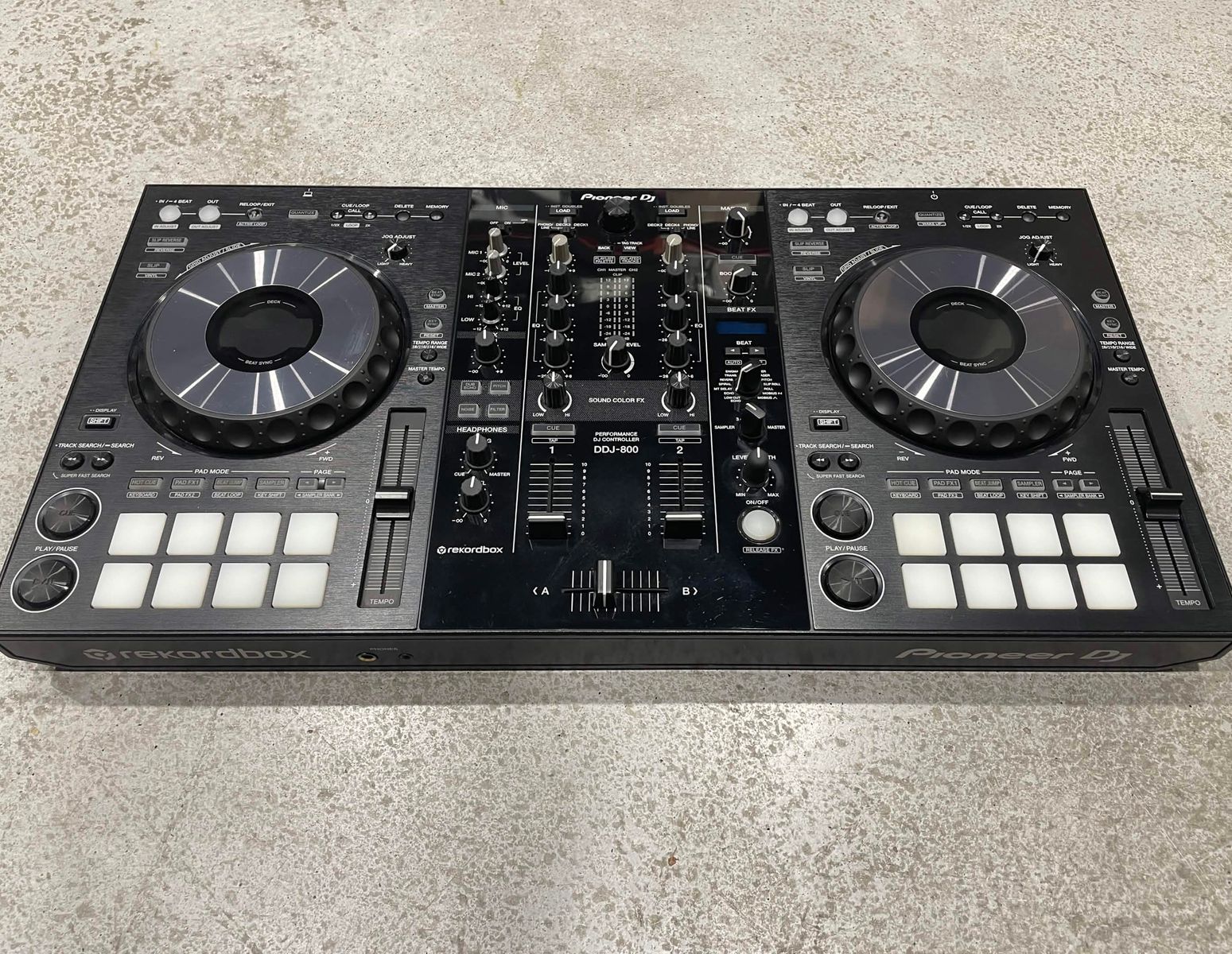
A compact, well-equipped controller with many of the features that made the DDJ-1000 so popular. Two physical channels will be enough for many DJs, and its 4.7 kg weight makes it considerably easier to carry. In our workshop experience, its main weakness is the jog wheel bearings, which we have repaired on several units.
Pioneer DDJ-1000: 8.5/10
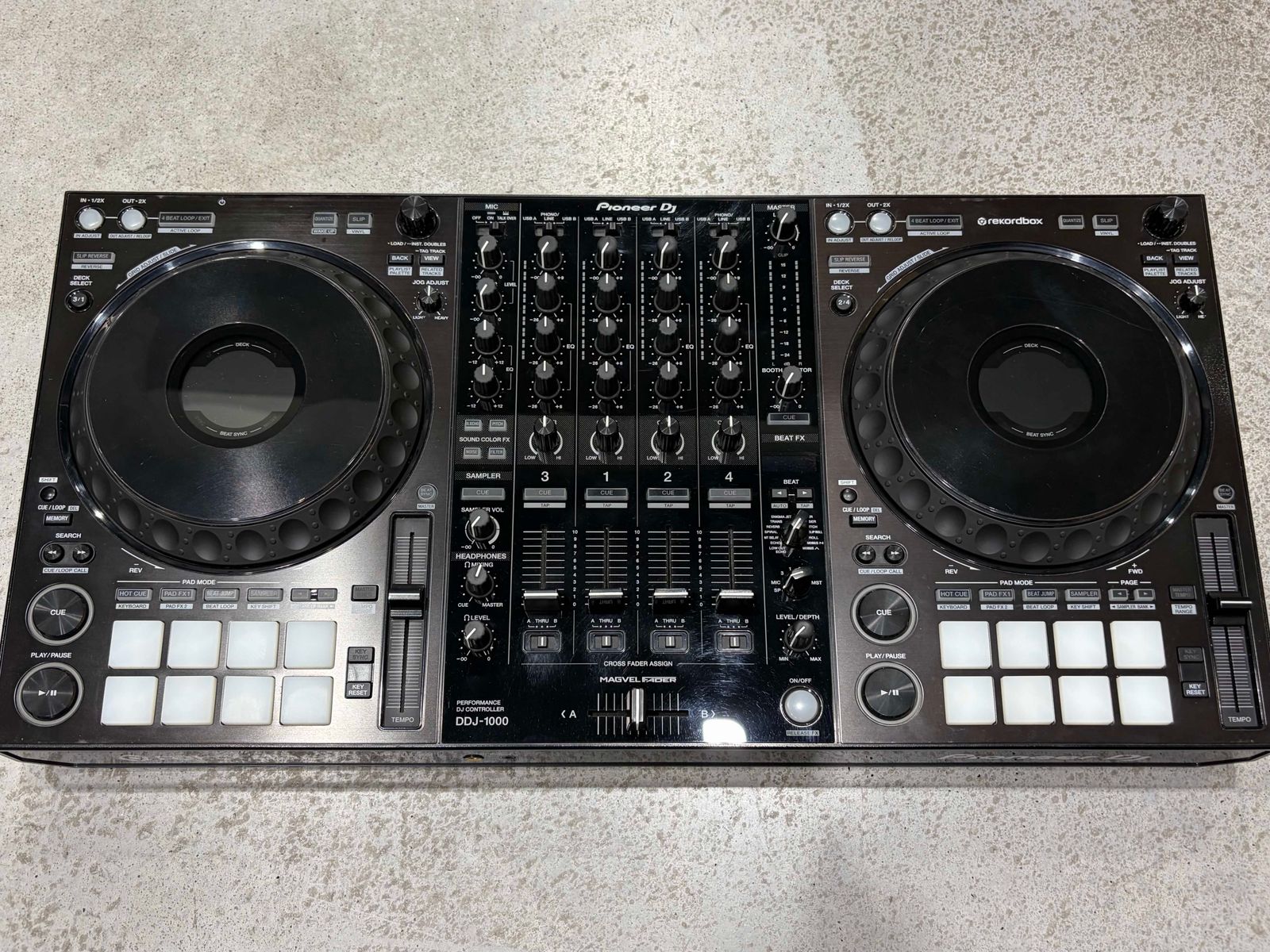
One of the standout computer-based DJ controllers of its generation. Four channels, full-size jog wheels, an excellent layout and plenty of physical controls still make it a very complete option. We have seen wear on some channel faders, but overall it has proved reliable and remains a strong second-hand choice.
Pros and cons
DDJ-800
Pros
- Compact and light.
- Two physical channels, enough for many DJs.
- Color On Jog Display and Jog Feeling Adjust.
- Eight Performance Pads per deck.
- Beat FX and Sound Color FX.
- Layout inspired by professional Pioneer DJ equipment.
Cons
- Considerably smaller jog wheels.
- Only two physical mixer channels.
- Our workshop has encountered numerous jog wheel bearing issues.
- Channel faders can become scratchy with use.
- Used prices can be relatively close to those of the DDJ-1000.
DDJ-1000
Pros
- Four physical channels.
- Full-size jog wheels with Jog Feeling Adjust.
- Color On Jog Display.
- Eight Performance Pads per deck.
- Beat FX and Sound Color FX.
- Layout closely related to a CDJ + DJM setup.
- More connectivity and room for expansion.
- Excellent second-hand option.
Cons
- Larger and heavier.
- Requires a computer for controller-based music playback, as does the DDJ-800.
- Channel faders can develop wear or noise over the years.
- Lacks the dedicated physical Stems integration of later models such as the DDJ-FLX10.
DDJ-800 vs DDJ-1000: key differences
| Feature | DDJ-800 | DDJ-1000 |
|---|---|---|
| Type | DJ controller | DJ controller |
| Physical channels | 2 | 4 |
| Controllable decks | 4 | 4 |
| Jog wheels | Compact | Full-size |
| Color On Jog Display | Yes | Yes |
| Jog Feeling Adjust | Yes | Yes |
| Performance Pads | 8 per deck | 8 per deck |
| Beat FX | 14 | 14 |
| Sound Color FX | 4 | 4 |
| Standalone playback | No | No |
| External-source mixer use without a computer | Yes | Yes |
| Weight | 4.7 kg | 6 kg |
| Approximate used price, September 2026 | €800 | €1,100 |
| Sounds Market Score | 8.2/10 | 8.5/10 |
The same approach in two sizes
The DDJ-800 brings much of the DDJ-1000 experience to a smaller, lighter controller with two physical channels. Both share a familiar control layout, jog wheel displays, Performance Pads and effects inspired by the Pioneer DJ ecosystem.
This is a choice between two versions of a similar concept: portability and two physical channels, or full-size jog wheels and a four-channel mixer. The DDJ-800 is already a well-equipped controller in its own right.
Two channels or four?
The DDJ-800 has a two-channel physical mixer, while the DDJ-1000 has four. If you always mix two tracks, the extra channels may make little difference to you.
The DDJ-800 can still control up to four rekordbox decks using its deck-selection buttons. The distinction is the number of physical mixer channels available at once.
The DDJ-1000 is more useful when you want to work with more channels simultaneously, add external sources or build a more complex setup. You can use just two channels for years and already have the hardware available when you decide to explore three or four decks. If size is not an issue, that flexibility adds real value.
Jog wheels: the biggest difference for us
The DDJ-1000's full-size jog wheels feel much closer to using CDJ players. The smaller DDJ-800 wheels still provide Color On Jog Display and Jog Feeling Adjust, so you retain both visual information and adjustable resistance.
If you are used to CDJs, or want to practise on a surface closer to a professional booth, we prefer the DDJ-1000. Our preference also reflects what we see in the workshop.
The DDJ-800's main weakness
We have repaired quite a few DDJ-800 units with jog wheel problems, particularly involving the bearings. With use, the wheels can lose smoothness, develop resistance or even jam.
This does not mean every DDJ-800 will develop the fault. We have encountered it often enough to consider it the model's main weakness.
When buying a used unit, check that both wheels turn smoothly, offer similar resistance and have no stiff spots during a full rotation. This is one of the areas we pay particular attention to when inspecting and refurbishing a DDJ-800.
Features: more similarities than differences
Both offer eight Performance Pads per deck, Color On Jog Display, 14 Beat FX and four Sound Color FX. For Hot Cues, loops, Beat Jump, Sampler, effects and a traditional rekordbox workflow, either is very capable.
The DDJ-1000's main advantages are hardware-related: more channels, much larger jog wheels and greater scope for expansion.
Neither has the same advanced physical Stems integration as a later controller such as the DDJ-FLX10. They remain perfectly viable for a traditional mixing workflow.
Can you use them without a computer?
Neither can load and play music directly from a USB drive as a standalone system such as an XDJ-RX3 or XDJ-XZ can. Controller-based playback requires a computer and DJ software.
Both can, however, use their mixer sections with connected external sources without a computer playing those sources. This is especially useful on the DDJ-1000, whose four channels and broader connectivity give you more scope to add players or turntables.
On the DDJ-800, applying software effects to external sources requires a connection to a computer running rekordbox. External mixer operation does not mean those effects are available without a computer.
The useful distinction is between standalone USB playback, which neither provides, and mixing externally supplied audio, which both support.
Portability: the main reason to choose the DDJ-800
The DDJ-800 weighs approximately 4.7 kg, compared with around 6 kg for the DDJ-1000, and takes up considerably less space.
That matters if you transport your controller regularly, work in tight spaces or want a home setup that is easy to put away. If two physical channels are enough and portability is your priority, the DDJ-800 makes a lot of sense. This is our main reason to choose it over the DDJ-1000.
The Sounds Market workshop's view
Our overall experience with both controllers is positive. The DDJ-1000 has proved fairly reliable. Over time, buttons can wear and channel faders in particular can become scratchy or produce noise, but we have not identified a serious recurring fault that makes us distrust the model.
We have also seen channel fader wear on the DDJ-800. In our view, these faders are not on the same level as those in high-end professional DJM mixers. The DDJ-1000's advertised MAGVEL FADER is the crossfader, not the channel faders.
The clearest difference is the DDJ-800's jog wheel bearings. We have repaired more issues in this area, so they are among the first things we check on a used unit. The DDJ-800 otherwise tends to work well; this is a specific weakness rather than a reason to dismiss the entire controller.
Price: where the DDJ-800 becomes harder to recommend
Using September 2026 prices as a reference, a DDJ-800 in good used condition is around €800, versus approximately €1,100 for a DDJ-1000 per unit.
Around €300 more buys four physical channels, full-size jog wheels, broader connectivity and room to expand your setup. The DDJ-800's difficulty is its price relative to the DDJ-1000, given how much extra hardware the larger model offers.
A much larger saving would make the DDJ-800 easier to recommend. With a gap of only €200 to €300, we would pay the difference for the DDJ-1000, provided its extra size is manageable.
Who should buy each model?
Choose the DDJ-800 if...
- You only need two physical channels.
- You want a compact controller.
- You transport your equipment frequently.
- You have limited space.
- You do not need full-size jog wheels.
- You find a unit noticeably cheaper than a DDJ-1000.
Choose the DDJ-1000 if...
- You can spend around €200 to €300 more.
- You want four channels.
- You want full-size jog wheels.
- You prefer a feel closer to a CDJ + DJM setup.
- You want more expansion options.
- The extra size and weight are acceptable.
Comparison ratings
Category ratings are relative to the products compared in this guide.
| Category | DDJ-800 | DDJ-1000 |
|---|---|---|
| Jog wheels | 7.5/10 | 9.5/10 |
| Mixer | 8/10 | 9/10 |
| Features | 9/10 | 9/10 |
| Build quality | 8/10 | 8.5/10 |
| Portability | 10/10 | 8/10 |
| Connectivity | 8/10 | 9.5/10 |
| Reliability | 7.5/10 | 8.5/10 |
| Value for money | 8/10 | 9/10 |
| Sounds Market Score | 8.2/10 | 8.5/10 |
The Sounds Market Score is an overall, independent editorial assessment of each product. It is not a ranking against the other model or an arithmetic average of the category ratings.
What other comparisons tend to miss
- Check a used DDJ-800's jog wheels carefully. Our bearing repair experience makes smooth rotation without stiff spots a priority.
- Four channels are not essential for everyone. If you always mix two tracks, size and portability may matter more.
- The DDJ-1000 remains a strong used buy. The arrival of the DDJ-FLX10 does not automatically make it obsolete. If you do not need newer dedicated Stems controls, it is still a very complete controller.
Frequently asked questions
Which is better, the DDJ-800 or DDJ-1000?
The DDJ-1000 offers more overall: four physical channels, full-size jog wheels and greater expansion options. The DDJ-800 has the advantage in size, weight and portability.
Is it worth paying €300 more for a DDJ-1000?
For us, yes. At the September 2026 reference prices, we would pay around €200 to €300 more for its four channels, full-size jog wheels and versatility, provided the extra size is acceptable.
Can the DDJ-800 control four decks?
Yes. It can control up to four decks in rekordbox using deck selection, although its physical mixer has only two channels.
Does the DDJ-800 have the same jog wheels as the DDJ-1000?
No. Both provide Color On Jog Display and Jog Feeling Adjust, but the DDJ-1000 has full-size jog wheels and the DDJ-800's are considerably smaller.
Does the DDJ-800 have jog wheel problems?
Not every unit does. In the Sounds Market workshop, we have repaired several with bearings that lose smoothness, develop resistance or jam. Check both jog wheels carefully when buying used.
Can you use either controller without a computer?
Neither offers standalone playback from a USB drive. Both can mix connected external sources without a computer playing them. On the DDJ-800, software effects on those sources require a computer running rekordbox.
Which is easier to transport?
The DDJ-800. It weighs approximately 4.7 kg and takes up considerably less space than the DDJ-1000.
Which feels closer to a professional DJ booth?
The DDJ-1000. Its full-size jog wheels, four-channel mixer and overall layout feel closer to using CDJ players with a DJM mixer.
Is the DDJ-1000 still worth buying in 2026?
Yes. If you do not need the dedicated Stems integration of later models, it remains a very appealing second-hand option among computer-based DJ controllers.
Thinking of upgrading your equipment?
If you own a DDJ-800, DDJ-1000, DDJ-FLX10 or other DJ equipment, you can sell it directly to Sounds Market or put it towards your next purchase.
Conclusion: DDJ-800 or DDJ-1000?
Both are very capable controllers built around a similar approach. The DDJ-800 makes sense if you want two physical channels, a smaller footprint and easy transport, while keeping many of the features of the larger model.
With a price difference of around €200 to €300, we would choose the DDJ-1000. Its four channels, full-size jog wheels and greater scope for expansion justify the extra cost for us. Our workshop experience also gives us more confidence in its jog wheels.
If your budget and available space allow, the DDJ-1000 is our choice.
- Best for transport: DDJ-800.
- Best for a compact two-channel setup: DDJ-800.
- Best jog wheels: DDJ-1000.
- Best for four channels: DDJ-1000.
- Closest to a CDJ + DJM booth: DDJ-1000.
- Best value at the reference prices: DDJ-1000.
- Sounds Market's choice: DDJ-1000.