Technics SL-1200/1210MK5 vs SL-1200M5G: which is better?
Last updated: September 30, 2026
The Technics M5G is the more complete turntable and our choice when price is not a factor. Selectable ±8/±16% pitch, horizontal tonearm-load adjustment and further refinements expand the classic platform's capabilities.
The MK5 offers better value for most DJs. If you do not need to go beyond ±8%, an excellent example is usually the more sensible purchase.
The Technics SL-1200/1210MK5 is one of the most refined developments of the classic Technics design. It retains the construction, motor and feel that made the SL-1200 a worldwide standard, with practical improvements for DJs.
The SL-1200M5G, also known as MK5G, takes that platform further with ±16% pitch, additional tonearm adjustment, OFC wiring and a distinctive premium finish. Launched in 2002 as the SL-1200 series' 30th-anniversary model, it occupies a special place in the family.
In the used market we work with at Sounds Market, it is considerably less common than the MK5. Our September 2026 reference is approximately €1,400 to €1,500 per unit. Do its improvements justify the premium?
Sounds Market Score
Technics SL-1200/1210MK5: 9.6/10
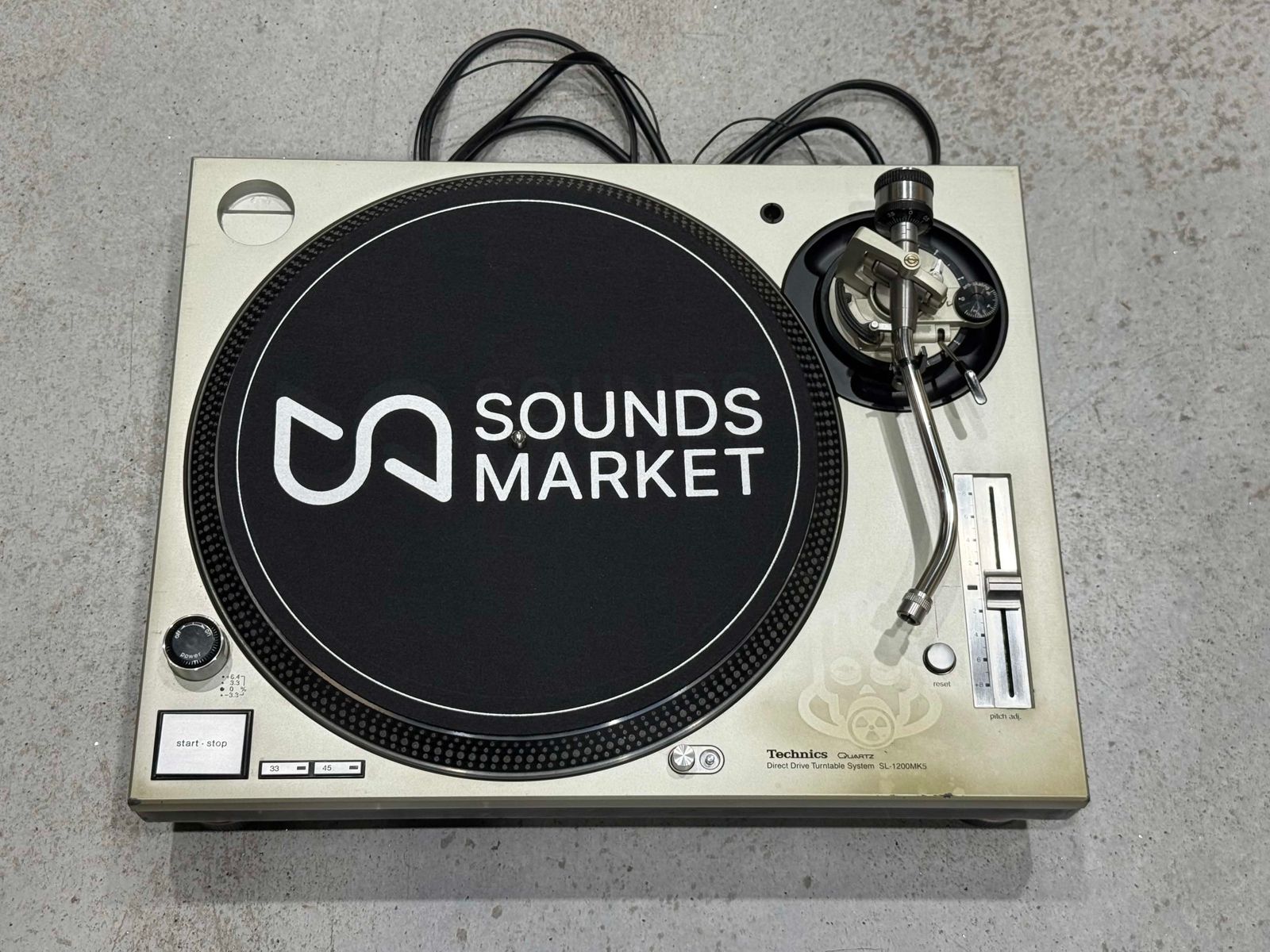
One of the best-built DJ turntables we have worked on. Exceptionally robust, reliable and repairable, it refines an already excellent platform.
Technics SL-1200M5G: 9.7/10
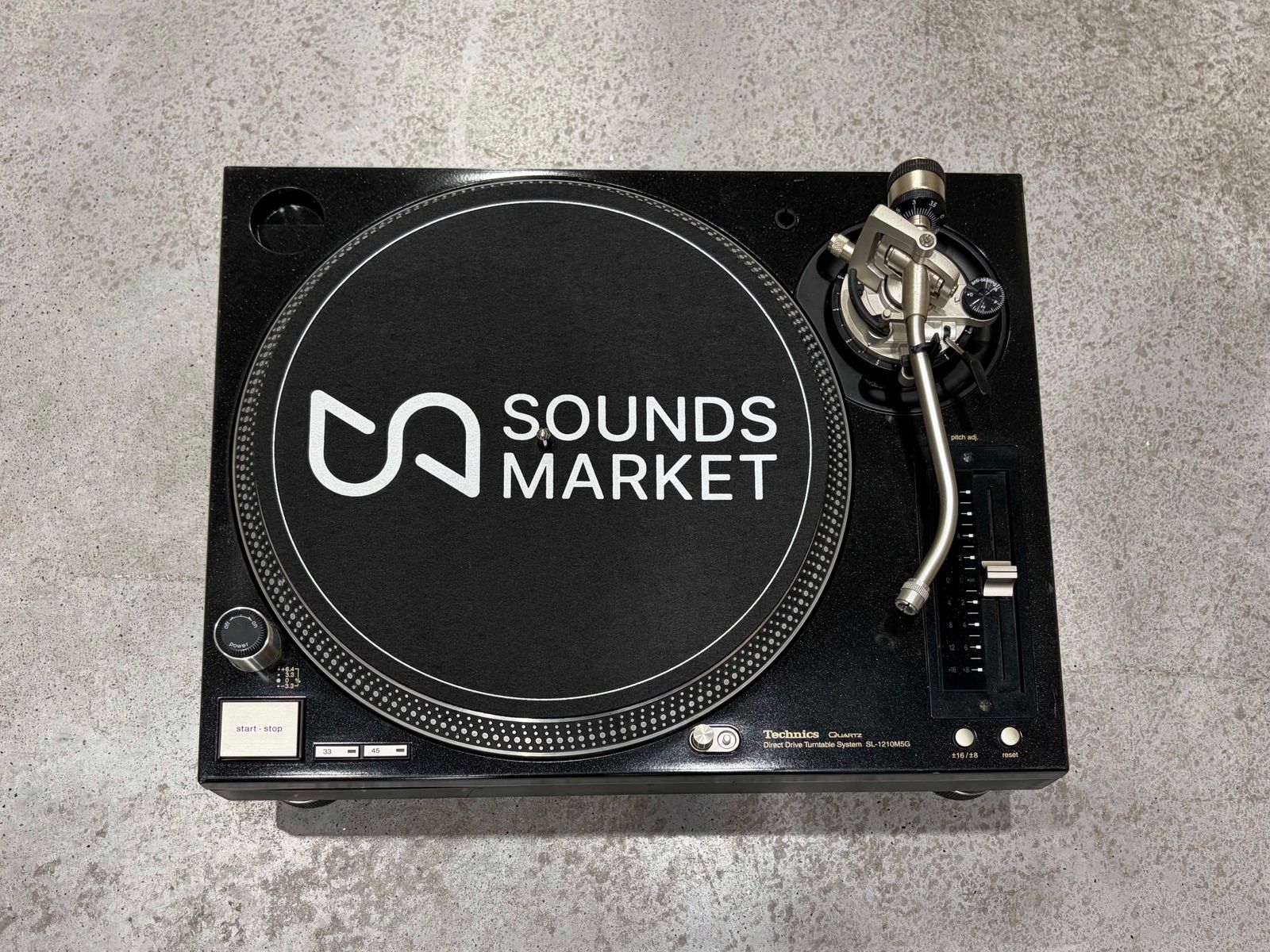
For us, the fullest expression of the classic SL-1200 DJ generation. It retains the MK5's principal strengths while adding more versatile pitch, tonearm improvements and a more premium specification.
The Sounds Market Score is our independent overall assessment of quality, construction, features, reliability and position within the category. It is not a ranking against the newest model or necessarily the arithmetic average of the comparison categories.
Pros and cons
Technics SL-1200/1210MK5
Pros
- Exceptional, extremely robust construction.
- Pitch without a centre click and independent Pitch Reset.
- Excellent stability and booth performance.
- Adjustable brake.
- Extended anti-skating adjustment.
- White LED stylus light.
- Highly repairable, with good spare-parts availability.
- More affordable than the M5G.
Cons
- Pitch limited to ±8%.
- Fewer adjustments than the M5G.
- Many units have years of use behind them.
- Some original spare parts can be expensive.
Technics SL-1200M5G
Pros
- One of the most complete classic Technics DJ turntables.
- Among the most robust and reliable decks we have handled.
- Factory-selectable ±8% / ±16% pitch, with no modification required.
- Particularly useful for tracks with large BPM differences.
- Horizontal tonearm-load adjustment.
- OFC tonearm wiring.
- Blue LED stylus light.
- Exceptional construction and repairability.
- Less common and particularly sought after.
Cons
- Much more expensive used.
- Harder to find in good condition.
- Some improvements will matter little to many DJs.
- Part of its price reflects its exclusivity.
Main differences
| Feature | SL-1200/1210MK5 | SL-1200M5G |
|---|---|---|
| Drive | Direct drive | Direct drive |
| Pitch | ±8% | ±8% / ±16% |
| Pitch centre click | No | No |
| Pitch Reset | Yes | Yes |
| Adjustable brake | Yes | Yes |
| Anti-skating | 0 to 6 | 0 to 6 |
| Horizontal tonearm-load adjustment | No | Yes |
| Tonearm wiring | Standard | OFC |
| Stylus light | White LED | Blue LED |
| Finish | Depends on version | Metallic black |
| Positioning | Standard model | Higher-specification / 30th anniversary |
| Sounds Market Score | 9.6 | 9.7 |
What actually changes when you DJ?
Factory ±8% or ±16% pitch
The MK5 offers ±8%, while the M5G lets you select ±8% or ±16%. For tracks with similar BPMs, the MK5 will usually be sufficient. Mixing across genres, eras or widely differing tempos can make the larger range a decisive advantage.
In our workshop, we see classic Technics decks modified for wider pitch ranges. When refurbishing them for sale, we normally restore factory specifications. The M5G provides that extra range without modifying the deck.
More range does not mean greater precision
With a similar physical fader travel covering a wider interval, each small movement produces a larger speed change. ±8% remains useful for fine conventional beatmatching, with ±16% available when you need bigger tempo shifts. The benefit is being able to choose.
Horizontal tonearm-load adjustment
The M5G's mechanism adjusts the horizontal load on the tonearm to help reduce stylus skipping during demanding DJ techniques. It can be useful for scratching, turntablism and more aggressive movements.
This is a real technical improvement, though it may be much less noticeable when primarily beatmatching house or techno.
OFC wiring and sound
The M5G uses OFC, oxygen-free copper, inside the tonearm. It is a specification upgrade, but we would not automatically expect a dramatic audible difference.
Cartridge, stylus, mixer, sound system, RCA condition, calibration and the turntable's general condition all influence the result. We would not choose the M5G solely for an assumed sound improvement.
Motor and feel
Both retain the familiar feel and stability of the classic generation. The M5G refines the MK5 platform; the main differences concern pitch, tonearm and details rather than a wholesale change of motor or playing experience.
Construction and reliability
We would call this a draw. At Sounds Market, we have worked on MK2, M3D, MK5 and M5G models and regard this classic generation as exceptionally well built.
We have not identified a recurring structural fault that makes either the M5G or MK5 less reliable than the other. Properly maintained examples can keep working exceptionally well after decades.
We have seen many older Technics decks perform brilliantly after careful ownership and appropriate servicing. The condition of the individual unit matters more than the model badge.
The Sounds Market workshop view
Most repairs on these generations relate to age and use rather than major design flaws.
RCA cables and audio wiring
RCA cables can deteriorate after decades of use. We replace them when necessary and check the entire audio path.
Earth connection
Some customers request an earth connection integrated into the RCA wiring, avoiding a separate earth lead. It can be convenient when connecting and disconnecting frequently. We assess it for the particular unit and installation rather than treating it as an automatic improvement.
Pitch
Older classic units can require their pitch system to be checked and adjusted to its correct parameters. We also encounter decks previously modified to increase their pitch range.
When applicable, we recalibrate to restore the proper settings. The M5G's practical advantage is that it offers up to ±16% from the factory without this type of range modification.
Spare parts
The SL-1200 family's popularity still supports a broad parts market. Good availability does not mean low prices: some original parts are expensive, and M5G-specific components may be harder to find.
Repairability nevertheless remains a major strength of both generations.
Workshop verdict
Both are excellent. We would choose the M5G for its broader capabilities, not because we expect it to outlast an MK5.
Why is the Technics M5G so sought after?
The M5G arrived in 2002 as the series' 30th-anniversary model, positioned above the MK5. Its metallic-black finish and distinctive lighting add to its appeal.
We also encounter considerably fewer M5Gs than MK5s in the used market. We do not know a sufficiently reliable official total production figure to give it a specific production run.
Its relative scarcity on the market, specifications and place in the SL-1200 family all contribute to demand. That does not establish a particular number manufactured.
Price: the M5G's main drawback
As a September 2026 Sounds Market reference, an M5G in good condition is around €1,400 to €1,500 per unit. An MK5 can generally be found for considerably less.
For most DJs, the improvements probably do not justify the full price difference. The MK5 already provides excellent construction, continuous pitch, Pitch Reset, a capable tonearm, adjustable braking, stability and repairability.
The M5G is more complete, but its performance advantage is not proportional to every premium you may encounter.
Is the M5G worth paying more for?
If you simply want an excellent Technics for DJ use, the MK5 is usually the more rational purchase.
If you want the most complete version of this classic generation, genuinely use ±16%, value the additional tonearm adjustment or want a particularly special SL-1200, the M5G makes more sense. Its appeal includes its place in Technics history as well as its functions.
Who should choose each model?
Choose the Technics SL-1200/1210MK5 if...
You want an outstanding classic DJ tool with a strong balance of performance, construction and price. For house, techno and conventional mixing within nearby BPM ranges, ±8% covers the vast majority of situations. This is our value-led recommendation.
Choose the Technics SL-1200M5G if...
You want the most complete classic DJ version, especially for ±16% pitch, horizontal tonearm-load adjustment or its less common, distinctive character. It is our choice when price is taken out of the equation.
Comparison scores
Scores are out of 10. Category scores compare these models; the Sounds Market Score is an independent overall assessment, not their arithmetic average.
| Category | MK5 | M5G |
|---|---|---|
| Construction | 10 | 10 |
| Reliability | 10 | 10 |
| Motor and stability | 9.5 | 9.5 |
| Pitch and control | 9.7 | 10 |
| Tonearm and adjustments | 9.6 | 10 |
| Repairability | 10 | 10 |
| Professional use | 9.8 | 10 |
| Value for money | 9.5 | 8.7 |
| Exclusivity | 9.0 | 10 |
| Sounds Market Score | 9.6 | 9.7 |
The M5G wins on features. The MK5 clearly wins on value for money.
What other comparisons often miss
±16% only adds value if you use it. If your music stays within nearby BPM ranges, the MK5's ±8% may meet your needs.
Condition matters more than the badge. We prefer an immaculate, maintained and calibrated MK5 to a heavily worn M5G. Every unit needs individual assessment.
Part of the price buys exclusivity. Market scarcity, finish and 30th-anniversary status all affect the M5G's value. Paying €1,400 to €1,500 does not guarantee a proportional improvement in performance.
Technics SL 1200 & 1210MK5 currently available
See all ->
Frequently asked questions
Which is better, the Technics MK5 or M5G?
The M5G. It retains the MK5's excellent foundation and adds up to ±16% pitch, tonearm improvements, OFC wiring and other refinements.
What are the differences between the Technics MK5 and M5G?
The main differences are the M5G's wider pitch range, horizontal tonearm-load adjustment, OFC wiring and distinctive finish details.
Does the Technics M5G offer ±16% pitch?
Yes. It lets you select ±8% or ±16%, compared with the MK5's ±8% range.
Does the M5G sound better than the MK5?
The M5G has OFC tonearm wiring, but many other elements affect sound in a DJ setup. We would not buy it solely expecting a clearly audible improvement.
Is the M5G more reliable?
We have not observed a significant reliability difference. Both belong to an exceptionally robust Technics generation.
How many Technics M5Gs were made?
We do not know a sufficiently reliable official total to give an exact number. In the used market we work with, the M5G is considerably less common than the MK5.
Is an M5G worth €1,400 to €1,500?
It can be, if you want one of the most complete classic Technics decks or regularly mix tracks with large BPM differences. Selectable ±8%/±16% is available from the factory, without the range modifications sometimes found on classic models. If you never need more than ±8%, the MK5 offers better value. If you often need the extra range, we choose the M5G.
Are spare parts still available for the MK5 and M5G?
Yes. The popularity of the SL-1200 family supports a substantial parts market, although original or model-specific components can be expensive and some M5G parts are harder to find.
Which would Sounds Market buy?
M5G if price is not a factor. MK5 for the more rational purchase as a working DJ tool.
Thinking of upgrading your Technics?
If you own a Technics SL-1200, SL-1210, MK2, M3D, MK5, M5G or other DJ equipment, you can sell it to Sounds Market or trade it in towards your next purchase.
Conclusion: Technics MK5 vs M5G
The M5G wins on features. Factory-selectable ±8/±16% pitch enables large tempo changes without modifying the turntable. Horizontal tonearm-load adjustment, OFC wiring and its distinctive finish complete one of our favourite versions of the classic generation.
The MK5 already offers outstanding construction, reliability and repairability. If you rarely need more than ±8%, an MK5 in excellent condition is the more sensible buy. If you need the wider range, want the most complete model or value its special character, the M5G can justify its September 2026 reference price of approximately €1,400 to €1,500 per unit.
- Best pitch: M5G.
- Best tonearm and adjustments: M5G.
- Construction: draw.
- Motor and stability: draw.
- Reliability: draw.
- Repairability: draw.
- Best value for money: MK5.
- Most complete model: M5G.
- Best overall turntable: M5G.
- Sounds Market choice: M5G.