XDJ-AZ vs Denon PRIME 4 G2: club familiarity or standalone innovation?
Last updated: September 30, 2026
The AlphaTheta XDJ-AZ and Denon DJ PRIME 4 G2 are two of the most ambitious four-channel all-in-one systems, but their priorities differ.
The XDJ-AZ brings a professional AlphaTheta/Pioneer DJ booth into one unit: four genuine standalone decks, full-size jogs with Jog Feeling Adjust, a four-channel mixer, a 10.1-inch touchscreen and a layout inspired by the CDJ-3000 and DJM-A9.
The PRIME 4 G2 also offers four standalone decks and a 10.1-inch screen, then adds onboard Stems processing, pressure- and position-sensitive MPCe Pads, FX Paddles, Fader FX, Touch FX, built-in DMX and an internal storage bay, all within Engine DJ.
At September 2026 reference prices, approximately €2,699 for a new PRIME 4 G2 and €3,000 or more for a new XDJ-AZ, the Denon also costs less.
Our initial assessment favours the PRIME 4 G2 for technology and creative possibilities. The AZ retains a major advantage in its familiarity with professional AlphaTheta/Pioneer DJ booths.
For a club-style experience and a rekordbox workflow: XDJ-AZ.
For the widest creative and standalone possibilities: PRIME 4 G2.
At this level, we think the new Denon deserves a hands-on trial before you decide.
Sounds Market Score
AlphaTheta XDJ-AZ: 9.5/10
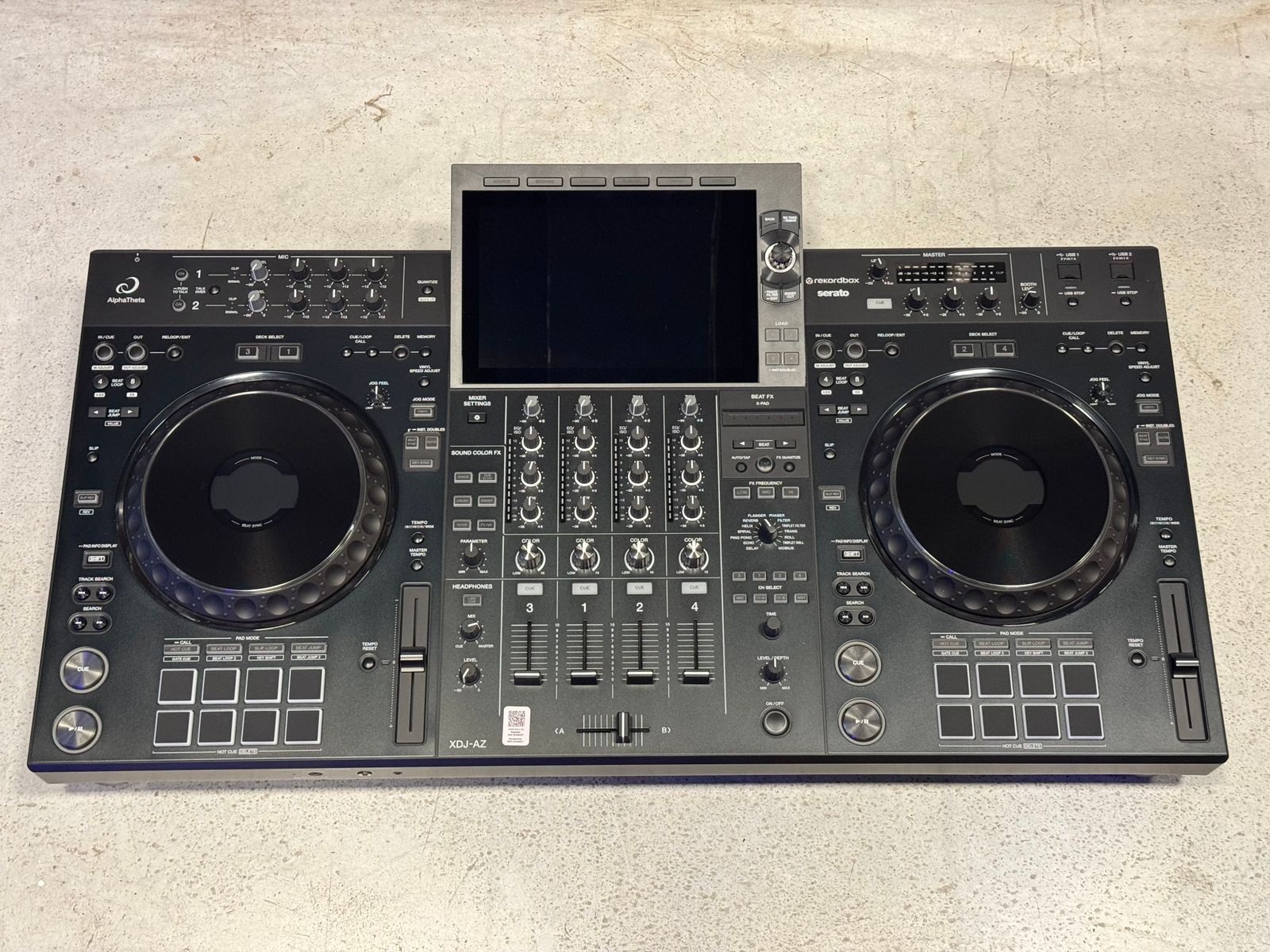
One of the best professional all-in-one systems we have tried. Excellent construction, full-size jogs, four genuine standalone decks and a layout close to CDJ-3000 plus DJM-A9. Its rekordbox integration and familiarity with professional booths remain compelling for regular club DJs.
Denon DJ PRIME 4 G2: 9.6/10
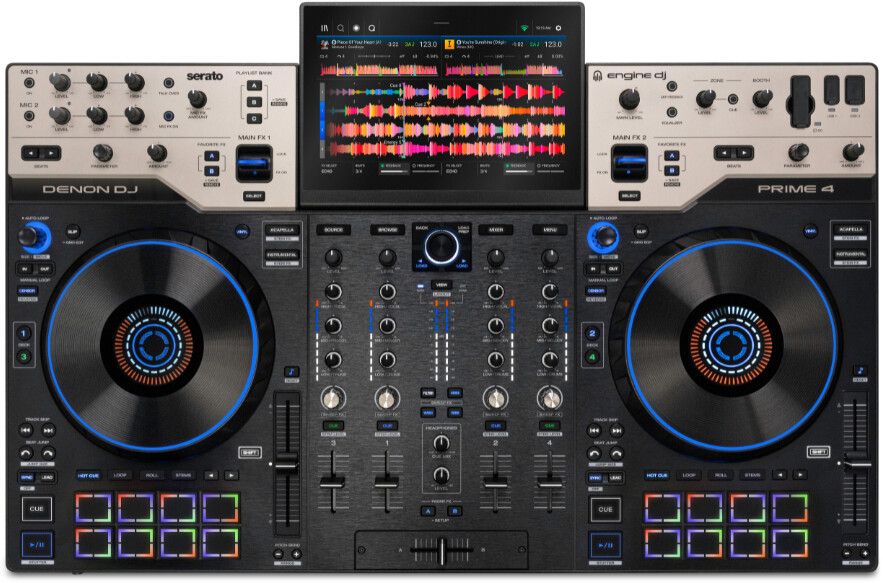
Our initial assessment is exceptional. On paper, it is probably the most technologically advanced all-in-one we have analysed so far. Onboard Stems, MPCe Pads, FX Paddles, Fader FX, Touch FX, DMX, internal storage and four standalone decks form a difficult combination to match.
This 9.6 is an initial rating. The PRIME 4 G2 has only just launched, and we do not yet have enough workshop experience to judge how it will age after years of use.
Pros and cons
XDJ-AZ
Pros
- Four genuine standalone decks.
- Four-channel mixer.
- 10.1-inch touchscreen.
- Full-size 206 mm jogs.
- Jog Feeling Adjust.
- Excellent build quality.
- Layout inspired by CDJ-3000 and DJM-A9.
- rekordbox workflow.
- Pro DJ Link.
- Excellent integration with external equipment.
- DJM-style Beat FX and Sound Color FX.
- Very good sound quality.
- Compatible with rekordbox and Serato DJ Pro.
- An ecosystem widely used in professional booths.
Cons
- High price.
- Weighs 13.5 kg.
- Fewer creative possibilities than the PRIME 4 G2.
- No comparable standalone Stems system.
- More conventional Performance Pads.
- No built-in DMX output.
- No internal SSD bay.
Denon DJ PRIME 4 G2
Pros
- Four genuine standalone decks.
- Tilting 10.1-inch HD touchscreen.
- Full-size 8-inch jogs.
- Stems processed onboard.
- Dedicated Stems controls.
- New MPCe Pads with 3D sensing.
- FX Paddles.
- 26 Main FX.
- Fader FX.
- Touch FX.
- Sweep FX.
- Favorite FX.
- Built-in DMX output.
- Lighting control from the unit.
- Internal SATA storage bay.
- Extensive streaming options.
- Weighs only 9.9 kg.
- Lower reference price than the XDJ-AZ.
Cons
- Engine DJ is much less common than rekordbox in club booths.
- The layout is less like a CDJ and DJM setup.
- Some advanced functions may be unnecessary for traditional mixing.
- We have no long-term workshop experience with it yet.
- Moving from rekordbox may require some adaptation.
- At launch it works with Engine DJ and SoundSwitch. Serato DJ Pro, Algoriddim djay and VirtualDJ support is planned for future updates.
XDJ-AZ vs PRIME 4 G2: key differences
| Feature | XDJ-AZ | PRIME 4 G2 |
|---|---|---|
| Channels | 4 | 4 |
| Standalone decks | 4 | 4 |
| Screen | 10.1-inch touchscreen | Tilting 10.1-inch touchscreen |
| Jogs | Full-size 206 mm | Full-size 8-inch |
| Jog Feeling Adjust | Yes | No direct equivalent |
| Performance Pads | 8 per deck | 8 MPCe per deck |
| Standalone Stems | No equivalent | Yes |
| Main / Beat FX | 14 Beat FX | 26 Main FX |
| Sound / Sweep FX | 6 Sound Color FX | 4 Sweep FX |
| Fader FX | No | Yes |
| Touch FX | No equivalent | 10 |
| FX Paddles | No | Yes |
| Built-in DMX | No | Yes |
| Internal storage | No | SATA bay |
| Pro DJ Link | Yes | No |
| Main ecosystem | rekordbox | Engine DJ |
| Weight | 13.5 kg | 9.9 kg |
| Sounds Market Score | 9.5/10 | 9.6/10, initial |
Two approaches to a flagship all-in-one
AlphaTheta has tried to condense a professional booth into one machine. Denon has tried to exploit the possibilities of modern standalone technology.
The AZ inherits much of the CDJ-3000 and DJM-A9 layout and feel. The PRIME 4 G2 does not simply imitate an existing booth: it adds functions absent from a traditional player-and-mixer setup. That distinction runs through the whole comparison.
Four genuine standalone decks on both
Unlike simply having a four-channel mixer, both systems can load and play four internal decks without a computer.
This matters when comparing them with earlier models such as the XDJ-XZ. For three- or four-deck DJs, both are genuine all-in-one alternatives to larger, more expensive configurations.
Screens: 10.1 inches, different priorities
The AZ's 10.1-inch touchscreen is a major step up from the XDJ-XZ. It supports comfortable library and waveform work, Touch Preview, Touch Cue, Playlist Bank and viewing up to four decks.
Denon's 10.1-inch screen tilts to adjust the viewing angle. Engine DJ makes it a deeper part of the operating system, covering libraries, Stems, effects, sources, mixer settings and configuration.
The AZ follows a more traditional club approach with many important functions directly accessible on physical controls. We do not see an absolute screen winner: it depends on the approach you prefer.
Jogs: professional dimensions on both
The PRIME 4 G2's new 8-inch jogs are a significant improvement over earlier generations and feel appropriately sized for a flagship.
The AZ uses full-size 206 mm jogs with a feel close to the CDJ-3000, plus Jog Feeling Adjust for changing resistance.
We still give the AZ the advantage here. The Denon's jogs are no longer small; our preference comes from the AZ's combination of size, resistance adjustment and familiarity with professional AlphaTheta players.
The AZ's major advantage: practising for the club
Its controls are directly inspired by CDJ-3000 and DJM-A9. The jogs, mixer, effects section and overall operating logic feel familiar to DJs used to Pioneer DJ/AlphaTheta.
Practising on an AZ at home and then playing on CDJs with a DJM mixer makes for a natural transition. The main controls and working habits are already familiar.
That is valuable for professional DJs and those aiming to play clubs regularly. Denon may offer more technology, but AlphaTheta retains a strong advantage in familiarity with many booths.
PRIME 4 G2: a broader standalone toolkit
Denon's new eight-core processor and 4 GB of RAM support a more ambitious platform. What matters is their use: Stems, effects, lighting, streaming, internal storage, advanced pads and tasks performed directly on the unit.
The AZ approaches a professional booth. The PRIME 4 G2 aims to reduce how much additional equipment you need around the all-in-one.
Stems: a major PRIME 4 G2 advantage
The PRIME 4 G2 can separate track parts on the unit and let you work with vocals, drums, melody and bass individually.
There are dedicated Acapella and Instrumental controls, Stems pad modes and ways to manipulate individual parts during a set, including level control through the mixer.
It can generate Stems onboard, although preparing them in Engine DJ beforehand makes sense for a quicker performance workflow. For DJs who actively use Stems, mashups and live remixes, the difference can be substantial.
MPCe Pads: the G2's most distinctive addition
There are eight MPCe Performance Pads per deck, sixteen in total. Comparing only their number with the AZ's eight pads per deck misses the point.
Denon's 3D sensing responds to position, pressure and velocity. Different areas of a pad can perform different actions: Filter Roll, Hot Cues combined with Stems, Hot Cue Rolls and XY effects are examples.
Moving a finger across a pad can change parameters in real time, and the pads can also control Engine Lighting.
Traditional mixing may not need any of this. For creative performance, it is one of the most advanced pad implementations we have seen in an all-in-one.
FX Paddles: a different way to perform with effects
Two Main FX modules use FX Paddles above the mixer. Push a paddle one way to latch an effect on, or the other way for momentary activation while you hold it.
That makes quick effect bursts during transitions very direct. It is different from the familiar DJM-style Beat FX section on the AZ.
We would not call either approach universally better, but Denon's design encourages a more immediate, performance-focused use of effects.
Favorite FX: keep your usual effects close
With 26 BPM-synchronised Main FX, finding the right one quickly matters. Favorite FX lets you save favourites and recall the combinations you use regularly.
Preparing them in advance is more practical than repeatedly searching a long list during a set. It is a small detail that can matter more than adding still more effects.
Fader FX: effects triggered by a fader move
Fader FX can respond to channel faders, the crossfader or both. Examples include Echo, Echo Down, Stutter Verb and Reverb Down.
A single movement can create a transition that would otherwise require several controls. It is optional for ordinary mixing, but shows how Denon combines software and hardware to offer new ways to interact with music.
Touch FX and Sweep FX
The PRIME 4 G2 adds ten Touch FX controlled with an onscreen XY pad, allowing simultaneous parameter changes. Four Sweep FX are available on the channel controls: Filter, Noise, Wash and Reverb.
Together with Main FX and Fader FX, this is a broad creative toolkit.
The AZ offers a familiar DJM-style arrangement with 14 Beat FX and six Sound Color FX.
AZ for traditional DJM-style effects workflows. PRIME 4 G2 for more experimentation and performance options.
Engine DJ or rekordbox: often the real decision
For many DJs, this matters more than screens, pads or effects. The AZ belongs to the rekordbox ecosystem; the PRIME 4 G2 primarily uses Engine DJ.
If you prepare your music in rekordbox and regularly play on AlphaTheta/Pioneer DJ club equipment, keeping your playlists, Hot Cues and preparation within familiar working habits has clear value.
Engine DJ takes a more ambitious standalone approach, moving many tasks traditionally performed on a computer onto the hardware.
The useful question is where you will use your music afterwards. For regular club DJs, rekordbox remains a major argument. For DJs mainly using their own machine, Engine DJ is very attractive.
At launch, the PRIME 4 G2 supports Engine DJ and SoundSwitch. Serato DJ Pro, Algoriddim djay and VirtualDJ compatibility is planned for future updates.
Streaming
Both go beyond traditional USB playback. The AZ offers StreamingDirectPlay with Apple Music, Beatport Streaming and TIDAL, plus rekordbox CloudDirectPlay.
Denon has also invested heavily in streaming within Engine DJ. Both systems can operate more independently of a computer than earlier generations.
We still see USB as fundamental to professional work and would not choose solely by the number of supported streaming services.
Built-in DMX: particularly useful for events
The PRIME 4 G2 has a physical DMX output. Engine Lighting and SoundSwitch let it control the first DMX universe without an external DMX interface. The MPCe Pads can also operate lighting functions.
That may be a minor feature for a club DJ. For mobile DJs, weddings, event companies and smaller venues where the DJ also handles lighting, it can be a major advantage.
Internal storage: install your own drive
The PRIME 4 G2 has an internal SATA bay so you can carry your library inside the unit.
For fixed installations, mobile DJs and large collections, that reduces reliance on external USB storage. The AZ has no equivalent internal bay.
Weight and portability
The AZ weighs approximately 13.5 kg, compared with 9.9 kg for the PRIME 4 G2: about 3.6 kg less for Denon.
A permanent installation may not care. If you transport the unit every week for weddings, events or gigs, it becomes significant, particularly given the additional hardware Denon integrates.
Build quality
We distinguish our own experience from specifications.
The AZ feels extremely well built. Its jogs, faders, controls, enclosure and overall feel meet our expectations of an AlphaTheta flagship. Sounds Market has not yet had to repair an AZ for a significant hardware fault.
Early units had firmware issues that were addressed through updates. In our experience, those initial issues are not a reason to advise against the model.
The PRIME 4 G2 has only just launched. Initial impressions are positive, including the new dual-rail channel faders, but we cannot responsibly rank its long-term reliability against the AZ.
We need to see how its jogs, pads, faders, screen, buttons and circuit boards age under intensive use.
The Sounds Market workshop's view
Our experience with the AZ so far is excellent, with no recurring hardware problem identified by our workshop. The initial firmware issues we observed were addressed with software updates.
We do not have an equivalent history for the PRIME 4 G2. Its complexity adds components and systems whose durability needs to be observed over time.
The 9.6/10 Sounds Market Score is therefore an initial assessment, mainly of its current product proposition. We will revisit it after gaining sufficient experience refurbishing and repairing PRIME 4 G2 units.
Reference prices, September 2026
The PRIME 4 G2 launched in Europe at approximately €2,699. A new XDJ-AZ is typically around €3,000 or more at the September 2026 reference prices, depending on retailer and timing.
The lower-priced Denon is not clearly inferior on paper. It offers more creative functions, Stems, built-in DMX, internal storage and a more ambitious effects system.
The AZ's extra cost is better explained by construction, workflow, jogs and especially the AlphaTheta/rekordbox ecosystem.
Is the XDJ-AZ worth paying more for?
For some DJs, particularly regular club performers, yes. If your library is in rekordbox and you want your home system to behave much like the CDJs you use professionally, the AZ makes strong sense. We also value its jogs and construction.
Without that reliance on the ecosystem, the premium is harder to justify. The PRIME 4 G2 offers a great deal, so automatically buying the AZ without trying the Denon would miss a worthwhile comparison.
Which should you choose?
Choose the XDJ-AZ if...
- You regularly play clubs.
- rekordbox is the centre of your library.
- You want a layout close to CDJ-3000 plus DJM-A9.
- You value full-size jogs with Jog Feeling Adjust.
- You want Pro DJ Link.
- You prioritise excellent construction.
- You prefer traditional DJM-style effects.
- You want home practice to resemble professional booths.
- You do not need advanced Stems or all of Denon's creative functions.
Choose the PRIME 4 G2 if...
- You want the widest standalone possibilities.
- You use or are willing to learn Engine DJ.
- You want to work with Stems.
- You use Performance Pads creatively.
- FX Paddles and Fader FX appeal to you.
- You enjoy experimenting with effects.
- You are a mobile or event DJ.
- You want lighting control from the unit.
- You want internal storage.
- Lower weight matters.
- You want as much technology as possible for your budget.
Comparison ratings
Category scores are relative to these two models. The Sounds Market Score is our overall product rating and remains independent of the comparison.
| Category | XDJ-AZ | PRIME 4 G2 |
|---|---|---|
| Technology | 9/10 | 10/10 |
| Jogs and controls | 10/10 | 9.5/10 |
| Screen and interface | 9.5/10 | 10/10 |
| Performance / creativity | 9/10 | 10/10 |
| Effects | 9.5/10 | 10/10 |
| Stems | 7/10 | 10/10 |
| Build quality | 10/10 | 9.5/10* |
| Club ecosystem | 10/10 | 8/10 |
| Portability | 8/10 | 9.5/10 |
| Value for money | 9/10 | 10/10 |
| Sounds Market Score | 9.5/10 | 9.6/10 |
*Initial assessment. We do not yet have enough workshop experience with the PRIME 4 G2 to judge long-term durability.
The Sounds Market Score is an overall editorial assessment and does not necessarily equal the arithmetic mean of these categories.
What other comparisons often miss
The ecosystem can matter more than the specification sheet. The AZ offers genuine CDJ and DJM familiarity for regular club work. That is its advantage, rather than the brand name alone.
Denon's technological advantages are real, but not everyone needs them. Onboard Stems, MPCe Pads, Fader FX, DMX and internal storage expand what you can do. DJs mainly mixing with EQ, filters, loops and an occasional effect may not need the extras.
The PRIME 4 G2's long-term durability is not yet established. We can assess its proposition and initial impressions, but cannot know how the components will perform after years of professional use.
If you are spending around €3,000 on an all-in-one, try both rather than choosing only through habit.
Frequently asked questions
Which is better, XDJ-AZ or Denon PRIME 4 G2?
Our initial assessment favours the PRIME 4 G2 for technology and functions. For club familiarity, rekordbox workflow and the professional AlphaTheta/Pioneer DJ experience, we prefer the AZ.
The decision depends more on your DJ work and ecosystem than on the longest specification list.
Can both use four decks without a computer?
Yes. Both can play four internal decks in standalone mode.
That differs from the XDJ-XZ, which has a four-channel mixer but only two internal standalone decks.
Does the PRIME 4 G2 have Stems without a computer?
Yes. It can use and generate Stems onboard. You can also prepare them in Engine DJ beforehand so they are ready for the set.
What are the PRIME 4 G2's MPCe Pads?
They are 3D-sensing Performance Pads that recognise different interactions and areas within each pad.
This enables more complex combinations of Hot Cues, Rolls, Stems, effects and lighting control.
Which has better effects?
The AZ uses a familiar DJM-style section with 14 Beat FX and six Sound Color FX.
The PRIME 4 G2 adds broader experimentation with 26 Main FX, FX Paddles, Sweep FX, Touch FX and Fader FX.
For creative possibilities, Denon wins. For DJM booth familiarity, we prefer AlphaTheta.
Which is better for club DJs?
For DJs regularly working with CDJs and DJM mixers, we would choose the XDJ-AZ. Its layout and workflow make the transition from home practice to a professional booth particularly natural.
Which is better for mobile DJs and events?
The PRIME 4 G2 has strong advantages: lower weight, built-in DMX, Engine Lighting control, internal storage and a wide range of tools without connecting a computer.
Which would we buy?
We would not automatically choose AlphaTheta this time. We love the AZ, and our experience of its construction and reliability so far is excellent.
The PRIME 4 G2 offers enough technology and creative possibilities at a lower reference price that we would want to try it before deciding. Its long-term durability is still awaiting workshop experience.
Thinking of upgrading your equipment?
If you own an XDJ-AZ, PRIME 4, PRIME 4+, XDJ-XZ or other DJ equipment, you can sell it directly to Sounds Market or trade it in towards your next purchase.
Conclusion: XDJ-AZ or Denon PRIME 4 G2?
This is an especially interesting all-in-one comparison because the two systems pursue different ideas of a flagship.
The XDJ-AZ translates the professional AlphaTheta/Pioneer DJ booth into an all-in-one: four standalone decks, full-size jogs with Jog Feeling Adjust, a four-channel mixer, a 10.1-inch screen and a layout inspired by CDJ-3000 and DJM-A9. Our experience of its construction and reliability so far is very positive.
The PRIME 4 G2 explores what a modern standalone system can do beyond recreating that traditional booth. It combines four standalone decks, Stems, MPCe Pads, FX Paddles, Fader FX, Touch FX, DMX, internal storage, streaming and Engine DJ. It also weighs less and costs less at the reference prices.
Our scores give Denon a slight initial lead:
XDJ-AZ: 9.5/10
PRIME 4 G2: 9.6/10, initial assessment without long-term workshop experience.
That tenth of a point is not an automatic recommendation. For regular club work, rekordbox preparation and practice on familiar controls, we would buy the XDJ-AZ.
If you do not depend on that ecosystem and want the broadest technology and creative toolkit in one machine, the PRIME 4 G2 looks particularly interesting.
If you are considering spending around €3,000 on an all-in-one, try the PRIME 4 G2 before automatically choosing the AZ. You may still prefer AlphaTheta, but Denon deserves a place in the decision.
More technologically advanced: PRIME 4 G2
Better Stems integration: PRIME 4 G2
More creative possibilities: PRIME 4 G2
Better for lighting and mobile DJs: PRIME 4 G2
Lighter: PRIME 4 G2
Better features for the price: PRIME 4 G2
Our preferred jogs: XDJ-AZ
Closer to CDJ + DJM: XDJ-AZ
Better rekordbox integration: XDJ-AZ
Better preparation for a club booth: XDJ-AZ
Our recommendation: try both before deciding.