Allen & Heath Xone:92 vs Xone:96: which is worth buying?
Last updated: September 22, 2026
The original Xone:92 remains an excellent choice for robust, straightforward analogue mixing without USB audio. The Xone:96 keeps an analogue mixing engine and adds dual USB audio interfaces, independent PHONES 2 monitoring, improved phono stages and cleaner filter switching.
Using Sounds Market's September 2026 price references, approximately €1,000 to €1,100 for the Xone:92 and €1,500 to €1,600 for the Xone:96, we would choose the 92 for a simple home setup. If you will use a computer, play B2B, mix vinyl or connect external hardware, we would pay the roughly €500 extra for the 96.
Sounds Market Score
Allen & Heath Xone:92: 9.3/10
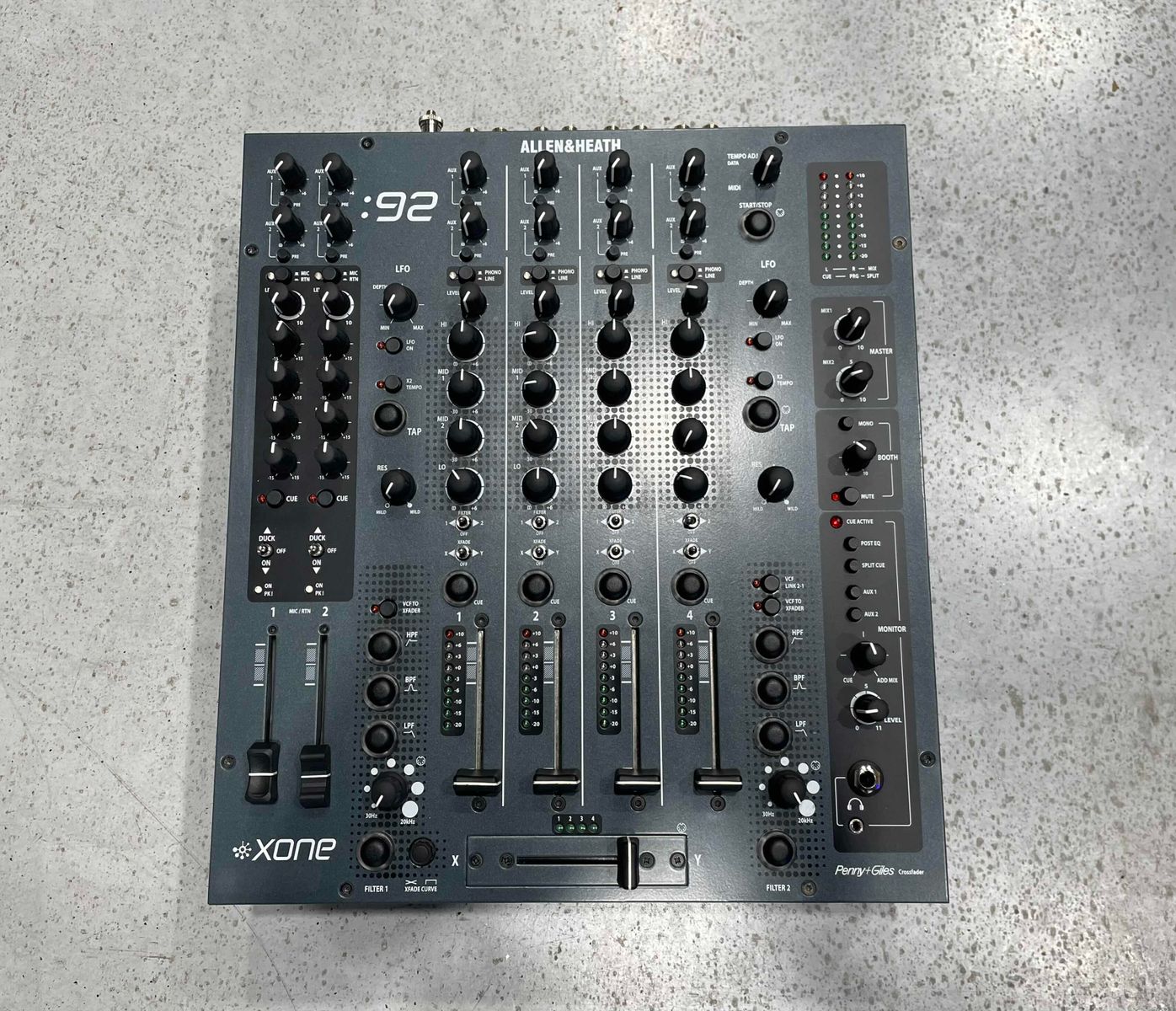
One of the most significant and robust analogue DJ mixers of recent decades. Its analogue audio architecture, four-band EQ, VCF filters and used value remain compelling. Its main drawbacks today are the age of many units and connectivity limitations compared with the 96.
Allen & Heath Xone:96: 9.6/10
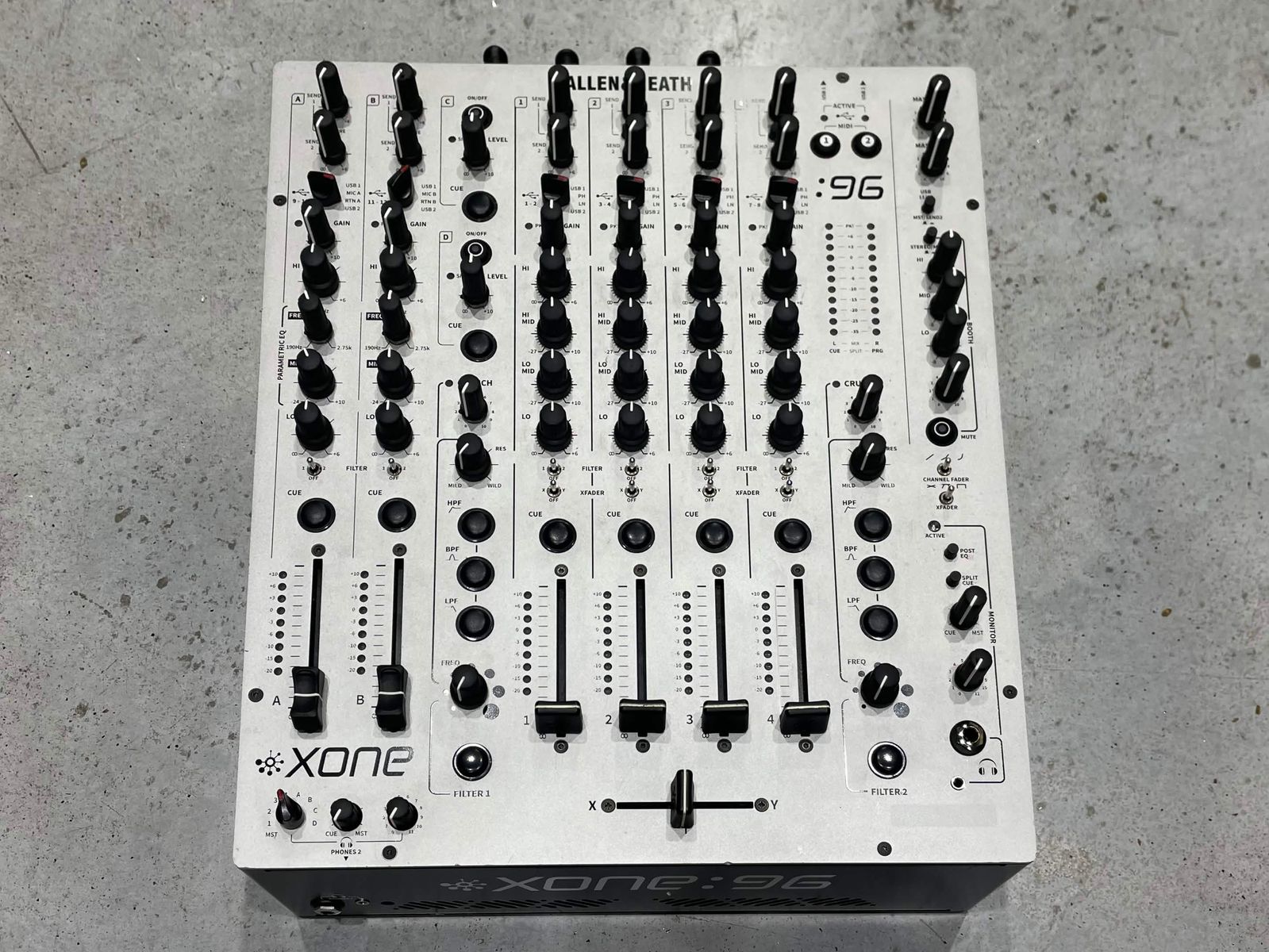
A comprehensive evolution of the Xone approach. Its main mixing architecture remains analogue, with dual USB audio interfaces, a second independent cue system, improved phono stages and greater flexibility for modern setups. We regard it as a particularly complete and well-balanced professional mixer.
Pros and cons
Xone:92
Pros
- Straightforward analogue mixing with a long track record.
- Four-band EQ and two VCF filters.
- PRE EQ / POST EQ cue monitoring and Split Cue.
- Excellent construction, with reliability demonstrated over more than two decades.
- Light channel faders, whose feel we personally prefer.
- Strong value on the used market.
Cons
- No USB audio interface and only one cue system.
- Less refined phono stages than the 96.
- A small click can occur when activating or assigning filters.
- Less flexibility for hybrid setups.
- Some units have accumulated many years of professional use.
Xone:96
Pros
- Analogue main mixing engine, four-band EQ and two VCF filters.
- PRE EQ / POST EQ cue monitoring and Split Cue in the main MONITOR section.
- Independent PHONES 2 monitoring.
- Dual USB audio interfaces.
- Improved phono stages compared with the original 92 and cleaner filter switching.
- Flexible connections for external hardware and effects.
- Very good construction and reliability.
Cons
- Costs approximately €500 more.
- We prefer the feel and resistance of the 92's channel faders.
- Some benefits go unused without a computer, B2B sets or external hardware.
- The additional connectivity brings complexity for DJs seeking simplicity.
Xone:92 vs Xone:96: main differences
| Feature | Xone:92 | Xone:96 |
|---|---|---|
| Mixing architecture | Fully analogue | Analogue with digital connectivity |
| Main channels | 4 | 4 |
| Additional return channels with faders | 2 | 2 |
| Main channel EQ | 4 bands | 4 bands |
| Filters | 2 VCF | 2 VCF |
| Filter activation | May produce a small click | Improved switching |
| PRE EQ / POST EQ cue | Yes | Yes |
| Split Cue | Yes | Yes |
| Second independent cue system | No | Yes, PHONES 2 |
| USB audio interface | No | Yes, dual |
| Phono | Yes | Improved over the original 92 |
| Send/Return | Yes | More flexible |
| Crossfader | Yes | mini innoFADER |
| Best suited to | Analogue simplicity and value | B2B, computers and flexibility |
Two analogue mixers with a similar philosophy
The Xone:96's main mixing architecture is analogue. Its digital connectivity, particularly the USB audio interfaces, does not make it simply a digital mixer.
The original Xone:92 has analogue audio architecture without an integrated USB audio interface. That straightforward approach is part of its appeal.
Four-band EQ
Both mixers provide High / High Mid / Low Mid / Low EQ on their main channels. Compared with a conventional three-band EQ, this offers finer control over the midrange and helps different elements of two tracks coexist during long blends.
That is a major part of the Xone appeal for techno, house and other styles built around extended transitions. The fundamental approach is shared by both.
Xone filters
Both have two independent analogue VCF filters, assignable to different channels, with Low Pass, Band Pass and High Pass modes. They are central to the Xone mixing experience.
On the original Xone:92, activating a filter or making certain assignments can produce a small click or pop. This does not necessarily indicate a fault: it can be associated with this generation's switching design. It can nevertheless be noticeable if you use the filters frequently.
The Xone:96 improves switching for cleaner activation, avoiding the original 92's characteristic click. This matters more during filter-heavy sets than a specification table might suggest.
The Xone:96's major advantage: integrated audio interfaces
The original Xone:92 has no integrated USB audio interface. The Xone:96 has dual interfaces for connecting computers and DJ software directly.
This is particularly useful with software such as Traktor, hybrid sets involving a computer, or changeovers between DJs bringing their own laptops. If a computer is a regular part of your setup, the 96 is the more logical choice.
Monitoring: PRE EQ, POST EQ and Split Cue
Both mixers let you globally select whether channel cue monitoring is taken before or after the EQ.
PRE EQ keeps the full track in your headphones even when you have cut frequencies before bringing it into the mix. POST EQ lets you hear the effect of your EQ adjustments.
Both also have Split Cue, placing cue in one ear and the programme signal in the other. These functions are already present on the 92. On the 96, they belong to the main MONITOR section.
PHONES 2: the Xone:96's B2B advantage
The Xone:96 adds PHONES 2, a second independent headphone monitoring system. Two DJs can prepare tracks independently without sharing the same cue selection.
The two sections are not identical. Main MONITOR provides PRE/POST EQ, Split Cue, CUE/MST Mix and Level. PHONES 2 has its own level, monitoring blend and source selector, but does not duplicate every main MONITOR control.
The 96 also offers configurable Auto-Cue and Latching-Cue behaviour. Latching-Cue allows multiple cue selections to remain active together. Both mixers have excellent monitoring, but PHONES 2 and these configuration options give the 96 greater flexibility.
Phono preamps
Both suit vinyl mixing, but in our experience the 96's phono preamps perform better than those of the original 92.
The classic 92 remains an excellent vinyl mixer thanks to its architecture, EQ and filters. Its phono stages are nevertheless an area where we welcome the 96's improvement, making the 96 our preference here for a vinyl-focused setup.
This comparison concerns the original Xone:92. The later Xone:92 MK2 introduced improvements to this and other areas.
Channel fader feel
At Sounds Market, we prefer the feel of the original 92's channel faders. They feel light and natural when mixing.
On the 96, we notice a different resistance depending on how quickly and how we move the fader, making the action feel less fluid to us. This is a subjective preference, not a claim of poor quality or a reliability problem.
It may be irrelevant to some DJs. If you make frequent, precise channel fader movements, try both if possible.
Send/Return and external setups
Both support external effects and equipment. The 96 offers greater flexibility for hybrid setups, routing and different sources, alongside USB integration.
On the 96, Send 1 can be pre-fader or post-fader; Send 2 is post-fader. Alongside the A/B return channels with faders listed in the table, it also has auxiliary C/D returns.
This can be valuable with pedals, effects units, drum machines or synthesisers. The 92 already supports substantial setups, while the 96 is better equipped for more complex configurations.
Is there a sound quality difference?
Both provide excellent professional analogue mixing. We would not choose between them solely on overall sound quality.
The more useful distinctions are phono preamplification, USB audio, cue monitoring, routing and the way you use the mixer. The 92 also has particular appeal if you want a straightforward analogue setup.
What changes when you are actually mixing?
With two or four players, no computer and a focus on EQ and filters, the core experience is close. The 92 already provides four-band EQ, VCF filters, PRE EQ / POST EQ and Split Cue for controlled, extended blends.
The 96 adds practical benefits: independent B2B preparation through PHONES 2, USB computer integration, our preferred phono stages and cleaner filter switching. Its sends, returns and connections also help when combining external effects and hardware.
The premium makes sense when you use these features. A simpler booth retains much of the Xone experience with the 92.
Build quality
Both are very well built. The 92 has the additional evidence of more than two decades in clubs, festivals, studios and homes, with many units still working well.
The 96 also has professional construction and our experience is very positive. We see no structural build issue in either that would make us advise against buying it.
Reliability
Xone:92
Its long service record is a strength. Many used examples are now old enough for wear-related maintenance to be expected.
Our workshop has seen older units with issues affecting Master outputs, filters, potentiometers and other analogue components. A mixer needing maintenance after many years of intensive use is not inherently unreliable. The number still working is evidence of its robustness.
Xone:96
Our experience is also very positive. We have not encountered a widespread fault serious enough to make us advise against buying it. As a newer generation, many used examples have accumulated fewer years of service than original 92s.
We consider both mixers very reliable.
The Sounds Market workshop's view
Both rank highly with us for construction and reliability. Repairs to old 92s often reflect expected wear after extensive service, rather than a specific defect that makes the model unsuitable.
The original 92's characteristic filter click does not necessarily mean a unit is faulty. The 96 improves that behaviour and has also proved robust in our experience.
Service history matters more than generation alone. A well-maintained home Xone:92 may be in better condition than a newer 96 used intensively in a club. Check filters, every input and output, faders, pots and all channels.
Used prices
Sounds Market reference prices for September 2026:
- Original Xone:92: approximately €1,000 to €1,100.
- Xone:96: approximately €1,500 to €1,600.
The indicative gap is around €500. Prices vary with condition, included accessories and market changes.
Is the Xone:96 worth the extra?
For home use with players or turntables and no need for computer integration, the 92 offers excellent value. Around €1,000 to €1,100 buys a robust analogue mixer whose design remains relevant.
We would pay roughly €500 more for the 96 if we needed integrated audio interfaces, regular B2B monitoring, improved phono stages, cleaner filter activation or more flexible external hardware routing.
The 92 continues to make sense for DJs who actively want its simplicity.
Which model do we recommend?
Choose the Xone:92 if...
- You want analogue mixing without needing USB audio.
- You mainly mix at home with players or turntables.
- Your budget is around €1,000.
- You value a straightforward, proven architecture.
- You prefer light channel faders.
- You want a recognised analogue mixer with a long record of robustness.
Choose the Xone:96 if...
- You want the more comprehensive platform.
- You use a computer or DJ software and need integrated audio interfaces.
- You regularly play B2B and want two independent cue systems.
- You mix a lot of vinyl and value improved phono stages.
- You use filters heavily and want cleaner switching.
- You connect external effects or hardware and need routing flexibility.
- You can budget approximately €500 more.
Comparison scores
Category scores are relative to the models in this comparison. The Sounds Market Score is our overall assessment of each product and stays independent of the comparison.
| Category | Xone:92 | Xone:96 |
|---|---|---|
| Features | 8.5/10 | 10/10 |
| Build quality | 9.5/10 | 9.5/10 |
| Reliability | 9.5/10 | 9.5/10 |
| Vinyl use | 9/10 | 10/10 |
| Filters / user experience | 9/10 | 9.5/10 |
| Monitoring / CUE | 9.5/10 | 10/10 |
| B2B | 7.5/10 | 10/10 |
| Computer integration | 5/10 | 10/10 |
| Value for money | 9.5/10 | 9/10 |
| Sounds Market Score | 9.3/10 | 9.6/10 |
The overall editorial score is not necessarily the arithmetic average of the categories.
What other comparisons may miss
The 92 already has comprehensive main monitoring. PRE EQ, POST EQ and Split Cue are shared. The 96 adds PHONES 2, which does not duplicate every main MONITOR control.
Feel and reliability are different judgements. We prefer the lighter 92 faders without considering the 96's deficient. The 92's characteristic filter click is not necessarily a fault either.
History matters more than appearance. Check filters, outputs, pots and channels on a unit with professional mileage. A newer generation alone is no guarantee of better condition.
A computer may decide the purchase. The 96's dual interfaces remove the need to add a separate multichannel audio interface. Without that need or a second cue system, the 92 still offers a lot for less.
Frequently asked questions
Is the Xone:96 better than the Xone:92?
For features, yes: integrated USB audio, a second independent cue system, improved phono stages, cleaner filter switching and greater flexibility. The Xone:92 remains an excellent option if you do not need those extras.
Is the Xone:96 analogue or digital?
Its main mixing architecture is analogue, with digital components and connectivity including USB audio interfaces. It should not simply be described as a digital mixer.
Is the Xone:92 fully analogue?
The original Xone:92 has an analogue audio architecture and no integrated USB audio interface.
Do both mixers offer PRE EQ cue monitoring?
Yes. Both offer PRE EQ / POST EQ selection in their main monitoring system. The 96's PHONES 2 is a separate system with different controls.
Do both have Split Cue?
Yes. The Xone:92 has Split Cue, and the Xone:96 provides it in its main MONITOR section.
Are the Xone:96's two headphone systems identical?
No. Main MONITOR includes PRE/POST EQ, Split Cue, CUE/MST Mix and Level. PHONES 2 has independent level, monitoring blend and source selection, but does not replicate every main control.
Why does the Xone:92 filter click?
The original switching design can cause a small click or pop when activating or assigning the filter. This does not necessarily indicate a fault. The Xone:96 improves switching for cleaner operation.
Which is better for vinyl?
Between the original Xone:92 and the Xone:96, we prefer the 96 for its improved phono preamps. The later Xone:92 MK2 also introduced phono improvements.
Which is better for back-to-back (B2B) sets?
The Xone:96. PHONES 2 gives a second DJ independent monitoring to prepare the next mix.
Can I connect a computer directly to a Xone:92?
It has no USB audio interface. For multichannel audio between your computer and mixer, you need an appropriate external audio interface.
Does the Xone:96 have a sound card?
Yes. It has dual integrated USB audio interfaces, a major difference from the original Xone:92.
Which has better faders?
We personally prefer the lighter feel of the original Xone:92's channel faders. This is a preference about feel, not a claim that the 96's faders are lower quality.
Which is more reliable?
Both are robust. The Xone:92 has demonstrated reliability over more than two decades, and our experience with the Xone:96 is also excellent.
Is paying €500 more for a Xone:96 worthwhile?
Yes, if you need USB audio, B2B monitoring, improved vinyl performance, cleaner filter switching or more flexible routing. For a simple analogue home setup, we would save the difference and buy a well-maintained 92.
Which would we buy?
For a fully analogue home setup focused on value, Xone:92. Starting from scratch and making use of the additional features, Xone:96.
Thinking of upgrading your equipment?
Sell your Xone:92, Xone:96 or other DJ equipment directly to Sounds Market, or use it in part exchange towards your next purchase.
Conclusion: Xone:92 or Xone:96?
At the September 2026 reference price of €1,000 to €1,100, the Xone:92 offers analogue mixing, four-band EQ, Xone filters and robustness proven over more than two decades. Its PRE EQ / POST EQ monitoring and Split Cue remain excellent. For home use with players or turntables, we would save the difference if the extra features are unnecessary.
At approximately €1,500 to €1,600, the Xone:96 retains analogue mixing and adds dual USB audio, PHONES 2, improved phono preamps, cleaner filter switching and more flexible connectivity.
We would pay around €500 extra if those improvements will be used, particularly for computer-based sets, B2B or vinyl. The 92 still appeals for its simplicity, fader feel and track record.
- Features, computers and connectivity: Xone:96.
- B2B and monitoring: Xone:96.
- Vinyl between these two: Xone:96.
- Filter switching: Xone:96.
- Our preferred fader feel: Xone:92.
- A straightforward analogue setup: Xone:92.
- Value without needing the extra features: Xone:92.
- Our choice when using its full capabilities: Xone:96.