The 5 best DJ controllers of 2026
Last updated: October 1, 2026
The best DJ controller is the one that suits the way you DJ.
Our five controllers and all-in-one systems cover different budgets, with options for Traktor, rekordbox and four standalone decks.
Choosing a DJ controller is not simply about buying the newest or most expensive one.
Some DJs need four channels, some prefer working with Traktor, some want a fully standalone unit, and others simply want a layout as close as possible to what they will find in a professional DJ booth.
For this selection, we have therefore chosen five controllers and all-in-one systems we would buy today for different needs and budgets.
Some have been discontinued for several years. Others belong to much more recent generations. Their prices range from roughly €600 to over €2,000.
That is exactly the point.
They are not ranked from worst to best, and a more expensive controller is not necessarily intended for a more advanced DJ.
The aim is to find the unit that makes the most sense for the way you DJ.
Quick answer
| If you want... | Our pick |
|---|---|
| 4 channels, Traktor and a budget of around €600 | Traktor Kontrol S4 MK3 |
| A robust 2-channel Pioneer DJ all-in-one offering excellent value | Pioneer XDJ-RX2 |
| 4 channels, rekordbox and an experience close to the CDJ + DJM ecosystem | Pioneer DDJ-1000 |
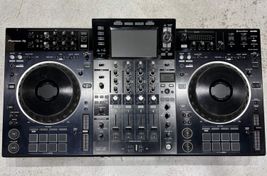
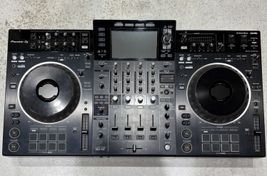
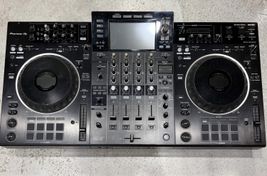
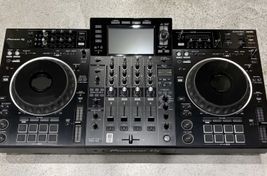
| A professional all-in-one that feels very close to an NXS2 booth | Pioneer XDJ-XZ |
| 4 standalone decks and a huge range of features for the money | Denon DJ Prime 4+ |
DJ controller or all-in-one system: which do you need?
Before comparing the five models, there is an important distinction.
The Traktor Kontrol S4 MK3 and DDJ-1000 need a computer to operate. They are DJ controllers in the traditional sense.
The XDJ-RX2, XDJ-XZ and Prime 4+ can operate standalone, allowing you to DJ directly from a USB drive without relying on a computer.
That does not automatically make an all-in-one a better unit.
A DJ who regularly works with Traktor may well prefer an S4 MK3. Another might want to use rekordbox on a computer with four channels and large jog wheels, finding exactly what they need in the DDJ-1000.
That is why we have included both types in this selection.
Native Instruments Traktor Kontrol S4 MK3
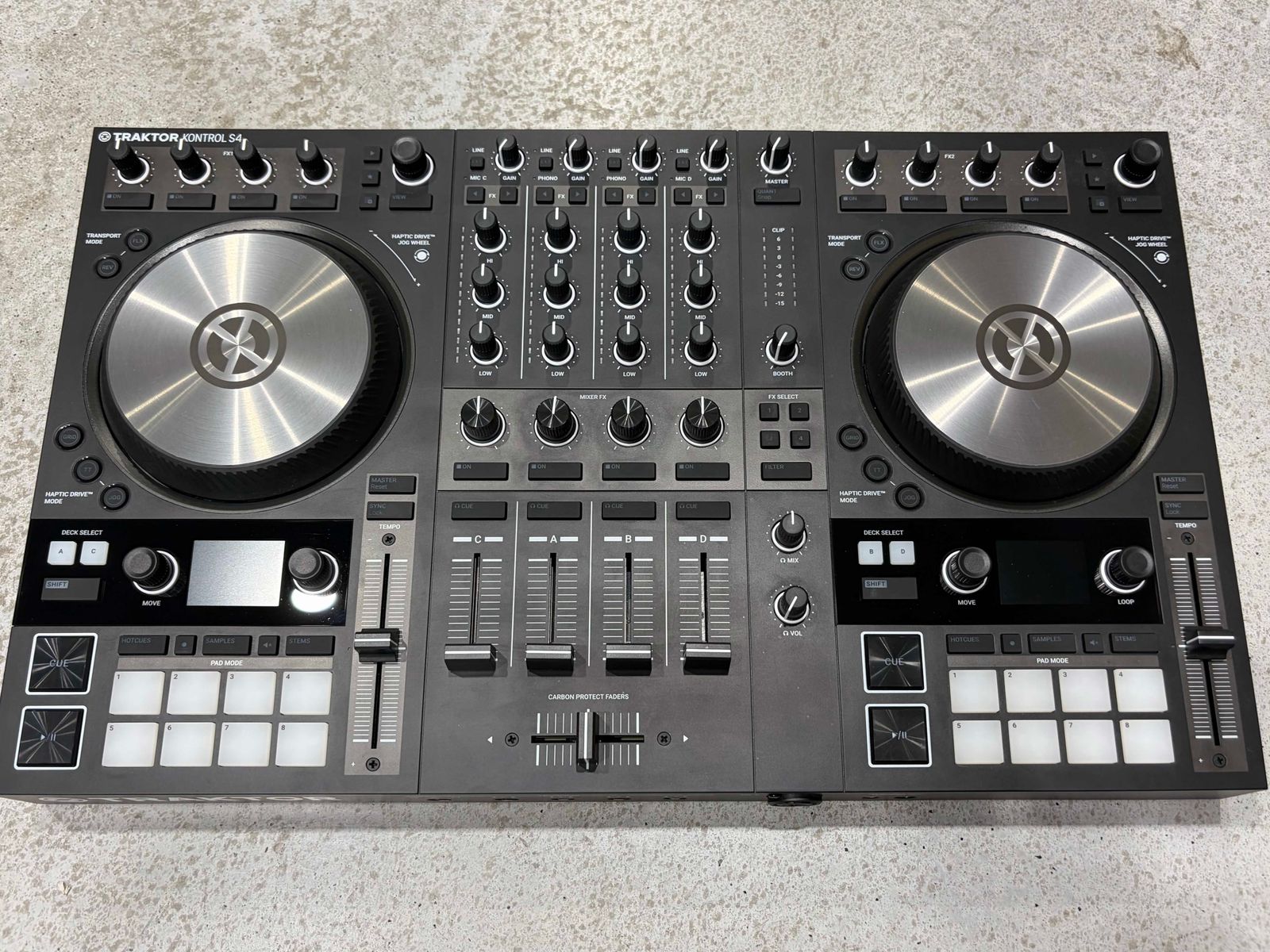
4 channels for around €600
The Traktor Kontrol S4 MK3 is probably the most affordable way into a serious four-channel controller in this selection.
Used units can currently be found for around €600, and it offers a great deal at that price.
It is designed specifically around Traktor Pro, with four channels, an integrated mixer, Performance Pads, effects controls and two small displays that let you check deck information without constantly looking at the computer screen.
One of its most distinctive features is its motorised jog wheels with haptic feedback.
Native Instruments uses its Haptic Drive system to provide different physical sensations when working with the jog wheels, including feedback when passing Cue Points and other elements in a track.
It is a very different approach from the one we find at Pioneer DJ.
What is its main limitation?
For us, the jog wheels.
Not because they work badly, but because they are considerably smaller than those on a DDJ-1000.
If you are used to professional CDJs or particularly value a large surface to work with, the difference is noticeable.
But we also need to put that into context.
We are talking about a four-channel controller that can be found for around €600.
At that price, if you work with Traktor and do not need a standalone unit, we think it is a particularly interesting option.
Who would we choose the Traktor Kontrol S4 MK3 for?
A DJ who uses Traktor, wants four channels and is looking to maximise their options while keeping the budget relatively modest.
We do not see it as a beginner controller. It simply meets a different need from the considerably more expensive standalone units in this selection.
Pioneer XDJ-RX2
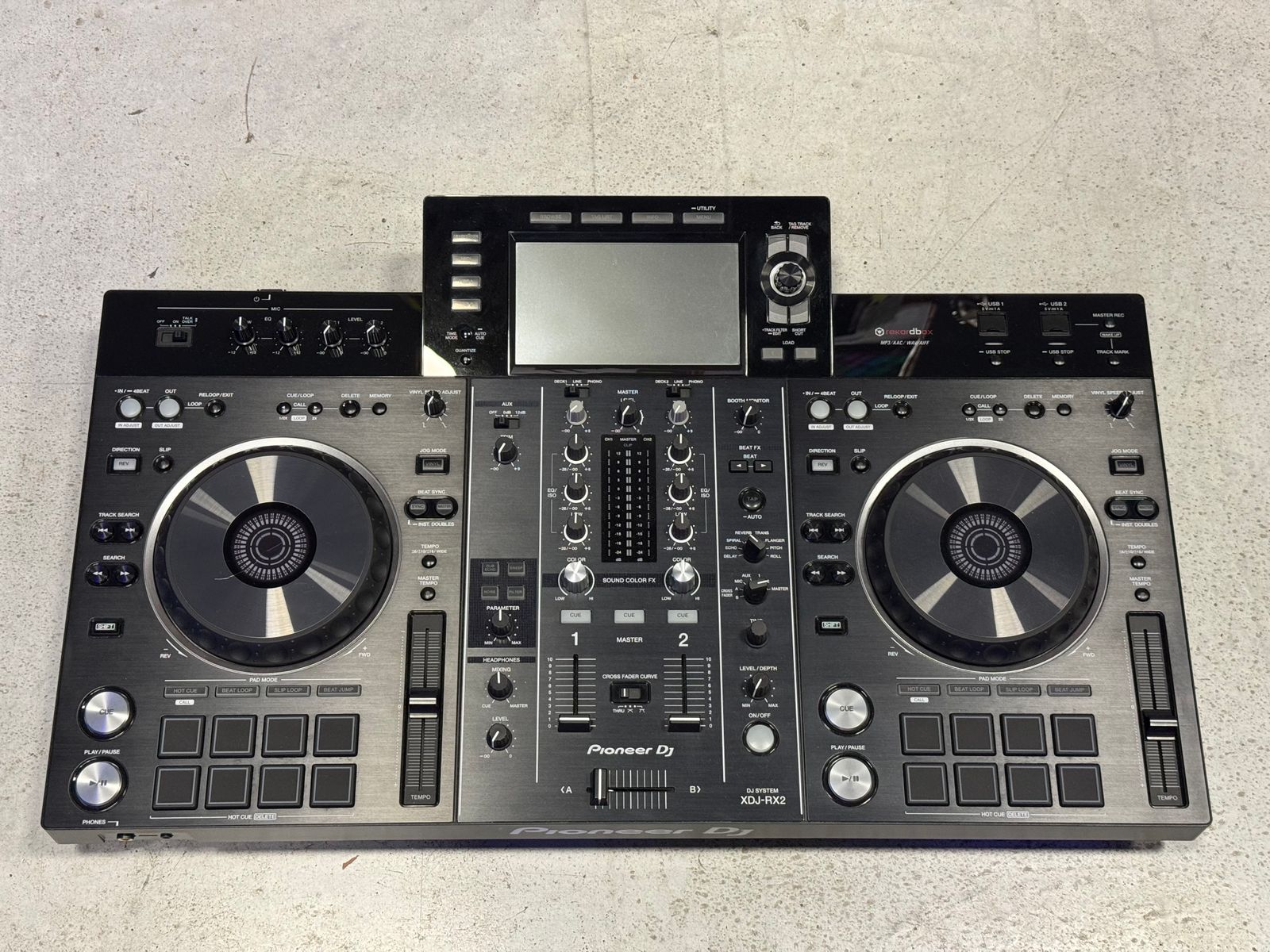
One of our favourite all-in-ones for value
The XDJ-RX2 is one of those products that perfectly demonstrates why an older generation can still be an excellent buy.
It is a two-channel standalone all-in-one with a familiar Pioneer DJ layout, a 7-inch touchscreen, Performance Pads, two USB ports and an effects section that remains comprehensive enough even today.
But one of the main reasons it is here does not appear on the spec sheet.
Our experience with the RX2 after working on many units has been particularly good.
It is very well built. The faders hold up well, the jog wheels age particularly well, and we have not identified any major structural issue that causes these units to deteriorate badly over time.
Naturally, we do encounter wear. Play/Cue buttons, other buttons, faders and components subjected to thousands of hours of use may need maintenance.
But that is exactly what we expect to find in any heavily used DJ equipment.
Why the RX2 rather than the RX3?
The RX3 is the better unit.
It has a 10.1-inch touchscreen compared with the RX2's 7-inch screen, considerably more modern browsing and other important improvements.
But the question is not only which is better. We also need to ask how much that improvement costs.
Considering used market prices, we still see a great deal of sense in buying an RX2 in good condition.
XDJ-RX2 vs XDJ-RX3: differences and which to choose
Who would we choose the XDJ-RX2 for?
Someone who wants a robust, easy-to-transport, two-channel Pioneer DJ standalone all-in-one with enough features to build a serious home setup.
We also think it is particularly appealing for anyone who wants to get familiar with the Pioneer DJ workflow without necessarily paying for a newer generation.
Pioneer DDJ-1000
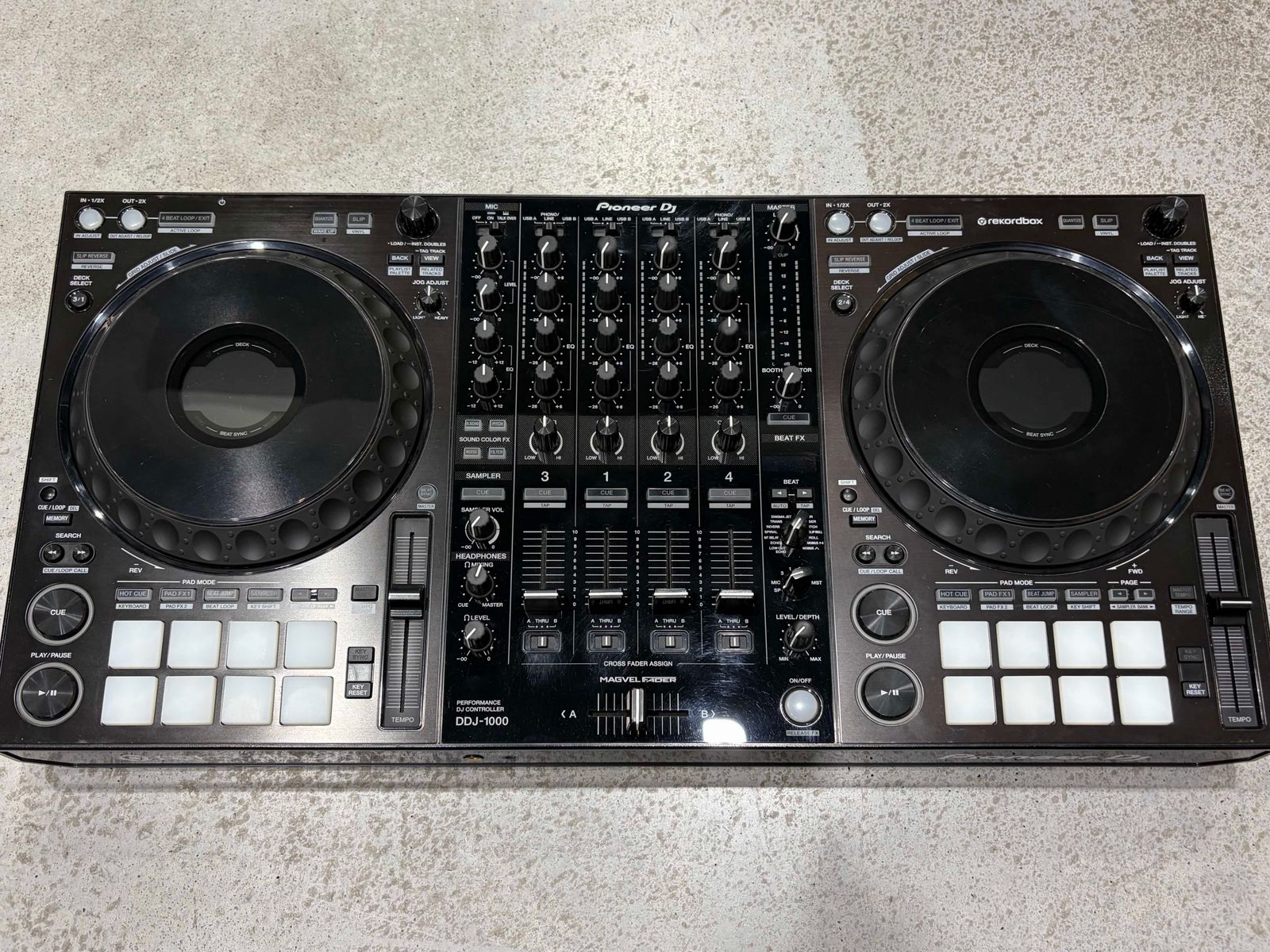
One of the best 4-channel controllers Pioneer DJ has made
If you do not need standalone operation and want to work with rekordbox, we still consider the DDJ-1000 an exceptional unit.
It has four channels, full-size jog wheels, Jog Feeling Adjust, Color On Jog Display, 8 Performance Pads per deck, 14 Beat FX and 4 Sound Color FX.
But what probably made this controller so good was its layout.
Pioneer DJ brought the experience of a computer-based controller much closer to the approach of a booth built around CDJs and a DJM.
The large jog wheels make an important difference compared with units such as the Traktor Kontrol S4 MK3, making the experience particularly familiar to anyone used to the professional Pioneer DJ ecosystem.
Does it still make sense now that the DDJ-FLX10 exists?
For us, yes.
The FLX10 brings the DDJ-1000 up to date, most notably adding much more advanced Stems integration.
If you use Stems constantly, the FLX10 makes a lot of sense.
But if you do not use them, the decision changes.
The core experience of both controllers is very similar, and a used DDJ-1000 can be found for roughly €400 less.
That is why it remains one of our favourite controllers for value.
DDJ-1000 vs DDJ-FLX10: differences and which to choose
How well does a DDJ-1000 age?
Our workshop experience is good.
We have found wear, particularly in faders and other components subjected to regular use, but we have not identified any recurring structural fault that would make us distrust the model.
Who would we choose the DDJ-1000 for?
Someone who wants four channels, works with rekordbox on a computer and particularly values full-size jog wheels and a layout very close to a traditional Pioneer DJ booth.
If you do not need dedicated Stems controls, it remains a particularly interesting buy.
Pioneer XDJ-XZ
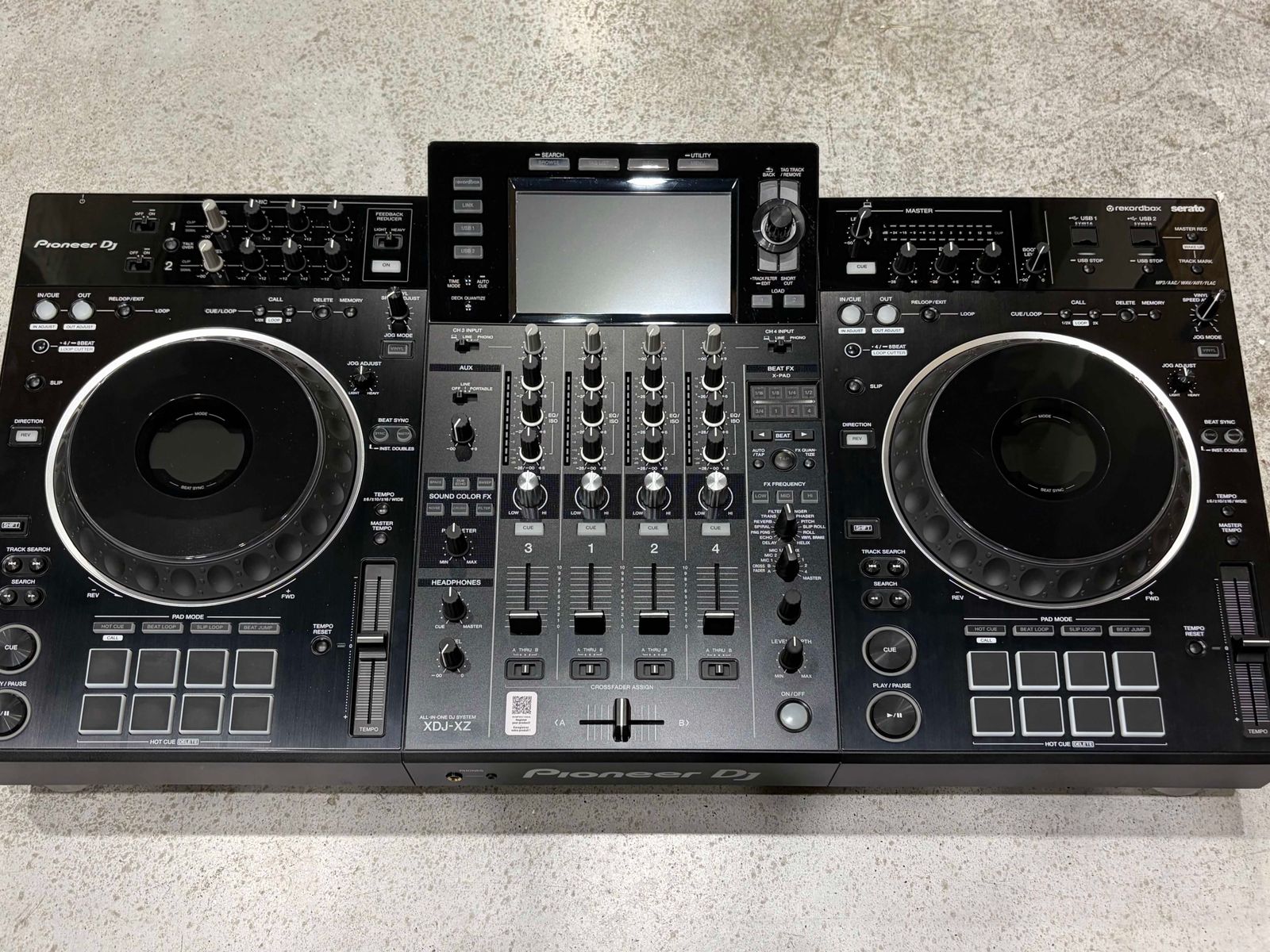
The closest thing to an NXS2 setup inside an all-in-one
The XDJ-XZ is one of our favourite units in this category.
The easiest way to understand it is to imagine an all-in-one built around the approach of Pioneer DJ's NXS2 generation.
Of course, there are not literally two CDJ-2000NXS2 players and a DJM-900NXS2 inside the same enclosure.
But the layout, 206 mm full-size jog wheels, four-channel mixer, Jog Feeling Adjust, PRO DJ LINK, Performance Pads, 14 Beat FX and 6 Sound Color FX make the experience very close to a professional Pioneer DJ booth from that generation.
We think it is a fantastic unit for practising at home before stepping up to a professional Pioneer DJ setup.
The XDJ-XZ's main limitation
It has a four-channel mixer, but that does not mean you get four standalone decks.
With only a USB drive connected, you have two internal decks.
To use channels 3 and 4, you need external sources, such as other players or turntables, or software running on a computer.
This is probably the XZ's biggest limitation, and one of the things AlphaTheta later addressed with the XDJ-AZ.
Build quality and reliability
We have a particularly positive view here.
We have worked on many XDJ-XZ units in our workshop and consider it an extremely robust machine.
The jog wheels withstand heavy use very well, overall build quality is excellent, and we have not identified any serious structural issue that would make the XZ a troublesome unit.
Why the XZ rather than the AZ?
The XDJ-AZ is a major step forward.
It has four genuine standalone decks, a 10.1-inch touchscreen, a considerably more modern platform and an experience inspired by the CDJ-3000 + DJM-A9 generation.
If budget were not an issue and we had to choose strictly between the XZ and AZ, we would choose the AZ.
But that does not make the XZ a bad buy.
It can be found for considerably less on the used market, and if you normally work with two decks, it still offers an excellent professional experience.
XDJ-XZ vs XDJ-AZ: differences and which to choose
Who would we choose the XDJ-XZ for?
Someone who wants a professional all-in-one, places a high value on build quality and full-size jog wheels, and wants an experience very close to Pioneer DJ's NXS2 generation.
Particularly on the used market, it remains one of our favourite units.
Denon DJ Prime 4+
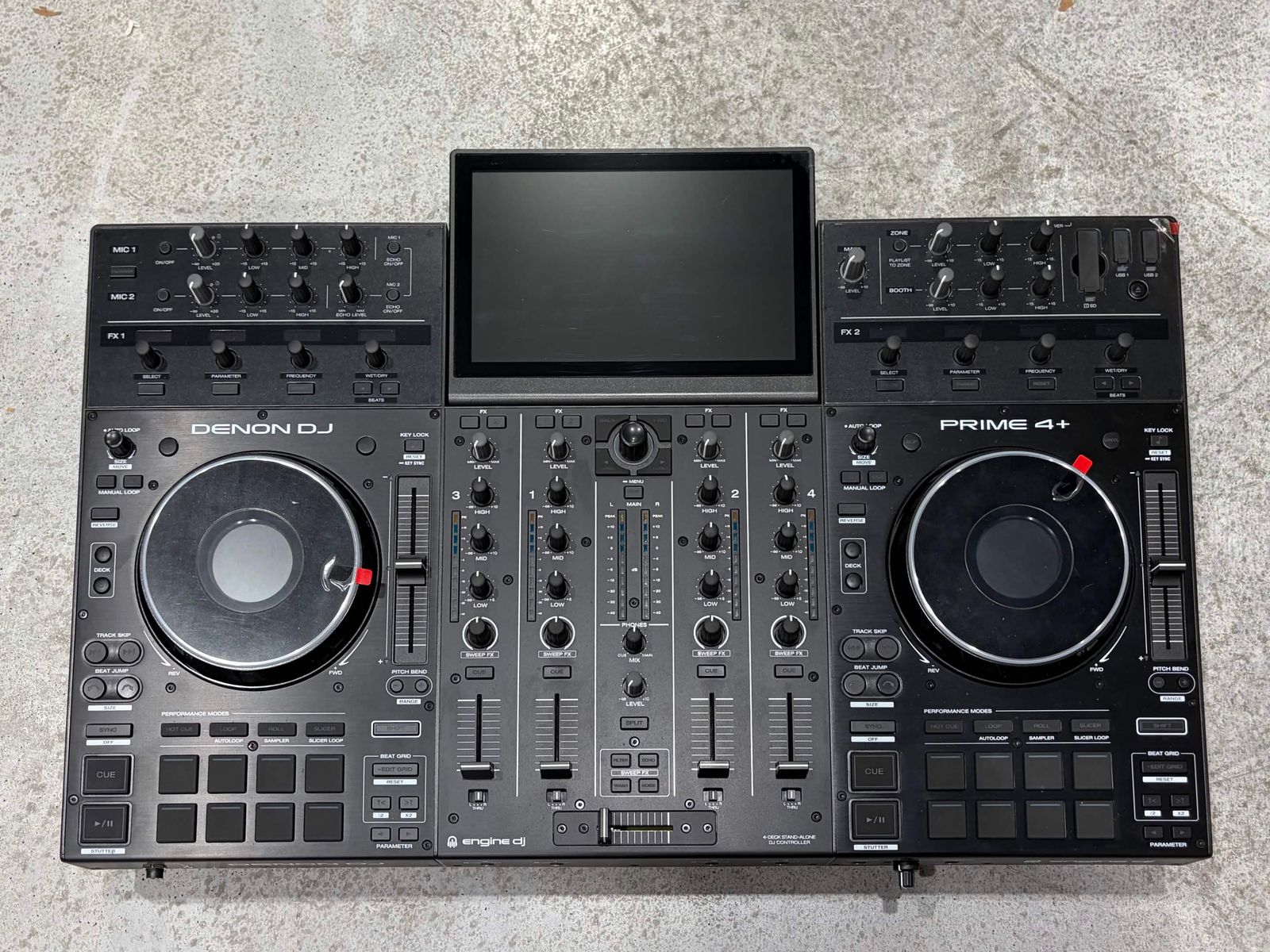
Four standalone decks for around €1,600
The Prime 4+ takes a very different approach.
That is exactly why it is in this selection.
For years, Denon has focused on bringing a huge range of functions directly to the hardware and reducing reliance on a computer as much as possible.
The Prime 4+ lets you work with four decks in standalone mode and has a four-channel mixer, a large 10.1-inch touchscreen, multiple storage options and an Engine DJ platform that is particularly advanced in connectivity and software features.
It also offers Wi-Fi and direct access to various compatible streaming services from the unit itself.
All of this becomes even more significant when we bring price into the equation.
For around €1,600, we are talking about a genuine four-deck standalone system.
Prime 4+ vs XDJ-XZ
This comparison is particularly useful for understanding what you are buying.
We especially like the XDJ-XZ for its build quality, full-size jog wheels, reliability and how closely it resembles the experience of a professional Pioneer DJ booth.
The Prime 4+ takes a different route.
It offers a more modern platform in many respects, four genuine standalone decks and a huge range of connectivity and software options.
It can also cost considerably less than an XDJ-XZ.
If we assess features per euro alone, the Prime 4+ is hard to ignore.
But choosing between them is not simply about counting features.
If your priority is getting used to the workflow and layout historically found in many professional booths, the XZ has a very strong case.
If your priority is maximum independence and functionality in a single unit, the Prime 4+ is outstanding.
Who would we choose the Prime 4+ for?
Someone who wants four standalone decks, does not want to rely on a computer and prioritises features, connectivity and software possibilities.
For around €1,600, we think it is a huge amount of equipment for the money.
Quick comparison
| Model | Channels | Standalone | Ecosystem | Main strength |
|---|---|---|---|---|
| Traktor Kontrol S4 MK3 | 4 | No | Traktor Pro | 4 channels for ~€600 |
| Pioneer XDJ-RX2 | 2 | Yes | rekordbox | Robustness and value |
| Pioneer DDJ-1000 | 4 | No | rekordbox | Full-size jog wheels and CDJ + DJM experience |
| Pioneer XDJ-XZ | 4-channel mixer / 2 internal USB decks | Yes | rekordbox | Build quality and NXS2 experience |
| Denon DJ Prime 4+ | 4 | Yes, 4 decks | Engine DJ | Features and 4 standalone decks |
Which DJ controller should you buy for your needs?
I want to spend around €600 and need 4 channels
Traktor Kontrol S4 MK3.
If working with a computer is not a problem and you like Traktor, it offers a great deal for the money.
I want a robust all-in-one for home
XDJ-RX2.
It is a unit we know particularly well, has demonstrated excellent reliability and still offers practically everything many DJs need.
I want 4 channels and large jog wheels, but I work with a computer
DDJ-1000.
Especially if you use rekordbox and do not need the FLX10's advanced Stems integration, it remains one of our favourite choices.
I want to practise on something very close to a professional Pioneer DJ booth
XDJ-XZ.
Its layout, jog wheels and mixer are strongly reminiscent of the NXS2 generation, and we think its build quality is excellent.
I want four standalone decks and a huge range of features
Denon DJ Prime 4+.
It is probably the most obvious choice of these five if you want to use four decks without a computer and prioritise functionality for your money.
Do I really need a standalone controller?
Not necessarily.
Standalone primarily means you can use the unit without relying on a computer.
That is extremely convenient and brings certain systems closer to the workflow of a professional booth.
But if you always DJ with your laptop, paying more simply to have standalone playback may not offer you much.
A DDJ-1000 or S4 MK3 can provide four channels and a huge range of possibilities for considerably less money.
The decision should depend on how you want to DJ, not on which format looks more professional.
Is buying a used DJ controller worth it?
In many cases, yes.
In fact, three of our five picks make particular sense on the used market.
The RX2, DDJ-1000 and XDJ-XZ belong to earlier generations, but remain extremely capable units.
The advantage is access to equipment that originally sat in higher price brackets for considerably less than its current successors.
Condition, however, is crucial.
A controller may have spent years in a bedroom or worked every week at events, clubs and in rental fleets.
Jog wheels, faders, buttons, connectors, screens and audio outputs are among the things we recommend checking before buying.
How to buy used DJ equipment: what to check before buying
At Sounds Market, we inspect and refurbish our Certified equipment before offering it for sale, and provide a one-year warranty.
Pioneer XDJ RX2 currently available
See all ->
Pioneer XDJ XZ currently available
See all ->

Native Instruments Traktor Kontrol S4 currently available
See all ->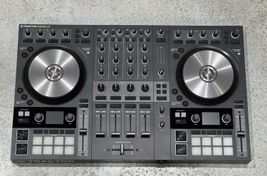
Frequently asked questions
What is the best DJ controller of 2026?
There is no single best controller for every DJ.
A Traktor Kontrol S4 MK3 can be an excellent buy for someone who wants four channels and uses Traktor, while a Prime 4+ makes much more sense for someone who needs four standalone decks.
The choice mainly depends on the software you use, whether you need standalone operation, how many channels you want and how much you want to spend.
Which DJ controller should I buy for rekordbox?
In this selection, the RX2, DDJ-1000 and XDJ-XZ belong to the rekordbox ecosystem, but meet different needs.
The RX2 is a two-channel all-in-one, the DDJ-1000 is a four-channel controller that needs a computer, and the XDJ-XZ is a professional standalone system with a four-channel mixer and two internal decks for USB playback.
Is buying an XDJ-RX2 worth it in 2026?
Yes.
The RX3 is technically superior, but our experience with the RX2's build quality and reliability is excellent, and it remains a very well-equipped unit.
That is why it is still one of our favourite used options.
Is buying a DDJ-1000 worth it in 2026?
Yes, especially if you do not need dedicated physical Stems controls.
It has four channels, full-size jog wheels and an excellent layout. The FLX10 is more modern and comprehensive, but the DDJ-1000 still offers very appealing value.
Does the XDJ-XZ have four standalone decks?
No.
It has a four-channel mixer, but only two internal decks when playing directly from USB.
The additional channels can be used with external sources or software.
The XDJ-AZ did address this limitation by adding four genuine standalone decks.
Which would we choose between the XDJ-XZ and Prime 4+?
It depends on the priority.
We especially like the XDJ-XZ for its build quality, reliability and jog wheels, and because it offers an experience very close to a professional NXS2-generation Pioneer DJ booth.
The Prime 4+ offers four standalone decks, a very advanced software platform and a huge range of features at a particularly competitive price.
If we prioritise familiarity with the Pioneer DJ ecosystem, the XZ.
If we prioritise features and four standalone decks for the money, the Prime 4+.
Do I need four channels to be a professional DJ?
No.
The number of channels does not determine a DJ's ability.
Many DJs mainly work with two decks. Four channels make sense when you actually want to use additional decks, turntables, external players or other sources.
Buying four channels simply because it looks more professional makes little sense if you are never going to use them.
These five units represent five quite different ways to build a DJ setup.
The Traktor Kontrol S4 MK3 shows that you can have four channels and a very capable system for around €600 if you are comfortable working with a computer.
The XDJ-RX2 represents almost the opposite: an easy-to-understand, robust, thoroughly proven all-in-one that remains one of our favourites for value.
The DDJ-1000 remains a benchmark among four-channel computer-based controllers. Its large jog wheels, layout and value mean it still makes a great deal of sense even with the FLX10 available.
The XDJ-XZ is one of our favourite units for build quality and user experience. It remains an excellent way to get close to the approach of an NXS2 booth in a single piece of equipment.
And the Prime 4+ shows how far an all-in-one can go today when functionality comes first: four standalone decks, a modern platform and a huge range of possibilities for around €1,600.
We would not choose one simply because it is the most expensive or has the most features.
We would choose the one that best suits the way we DJ.
Because a €600 controller can be exactly the tool a professional DJ needs, just as an all-in-one costing over €2,000 may make no sense for someone who only uses two channels and always works with a computer.
A DJ's ability is not determined by the price of their controller.